Read the passage carefully and answer the following questions.
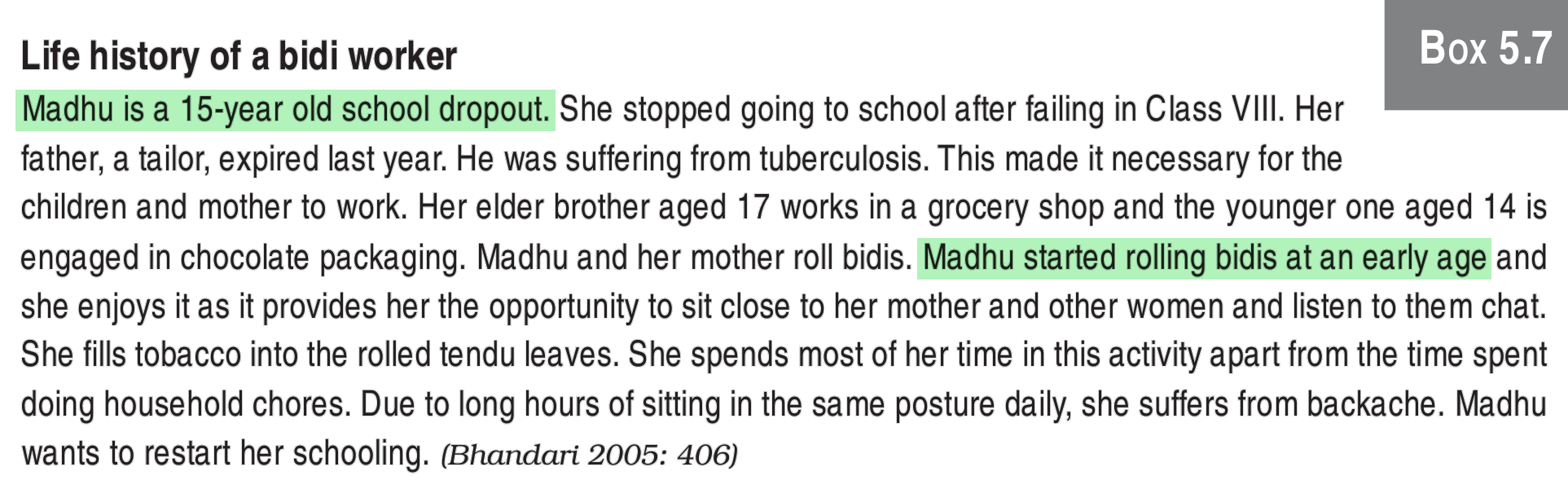
Madhu is a 15-year old school dropout. She stopped going to school after failing in class VIII. Her father, a tailor, expired last year. He was suffering from Tuberculosis. This made it necessary for the children and their mother to work. Her elder brother aged 17 years works in a grocery shop and the younger one aged 14 years is engaged in chocolate packaging. Madhu and her mother roll bidis. Madhu started rolling bidis at an early age and she enjoys it as it provides her the opportunity to sit close to her mother and other women and listen to them chat. She fills tobacco into the rolled tendu leaves. She spends most of her time in this activity apart from the time spent doing household chores. Due to long hours of sitting in the same posture daily, she suffers from backache. Madhu wants to restart her schooling.
Madhu's work as a bidi worker is an example of:
Answer & explanation
Correct answer: option 2
The correct answer is Option (2) → Child labour
Option (1) Industrial labour — Incorrect. Industrial labour is the work done in factories and mills, where many workers come together under one roof and each does one small part of a product. Madhu does not go to any factory; she rolls bidis sitting with her mother and other women, which is home-based work.
Option (2) Child labour — Correct. Madhu is a 15-year old school dropout who started rolling bidis at an early age and now spends most of her time at it. Work that a child does for the family’s income, in place of going to school, is child labour. Home-based work such as bidi rolling is mainly done by women and children, and Madhu still wants to restart her schooling.
Option (3) Free labour — Incorrect. In rural India, begar or free labour meant that members of low-ranked castes had to work a fixed number of days every year for the village zamindar or landlord. Madhu works because her family needs the earnings after her father’s death, not because she owes labour to a landlord.
Option (4) Abuse — Incorrect. Abuse means cruel or harmful treatment of a person by someone else. Nobody in the passage ill-treats Madhu; she even enjoys sitting close to her mother and listening to the women chat. The point of the passage is a child working instead of studying.
Note 1: The passage is Box 5.7, ‘Life history of a bidi worker’, of the chapter ‘Change and Development in Industrial Society’. It was there in the pre-rationalised NCERT, which NTA followed in 2023. This box has been deleted from the NCERT book (2025-26), though the chapter and its section on home-based work are still there.
Note 2: This is an application-based question. The term ‘child labour’ is not used in NCERT; the book says that home-based work such as bidi rolling is mainly done by women and children. The answer comes from applying this to Madhu’s case: she is a child who began rolling bidis at an early age and now works for the family’s income in place of going to school, which is what child labour means.
NCERT (2025-26): “5.6 Home-based work … Home-based work is an important part of the economy. This includes the manufacture of lace, zari or brocade, carpets, bidis, agarbattis and many such products. This work is mainly done by women and children. An agent provides raw materials and also picks up the finished product. Home workers are paid on a piece-rate basis, depending on the number of pieces they make.…”
Box 5.7, Life history of a bidi worker (Pre-rationalised NCERT) |