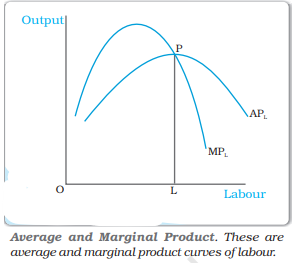
Chronologically, arrange the following statements in the context of shape of AP curve.
(A) MP starts falling, the AP continues to rise as long as MP remains higher than AP.
(B) At the first level of output, the MP and the AP are the same.
(C) MP fall sufficiently, its value becomes less than the AP and the AP also falls.
(D) MP rises, AP being the average of marginal products, also rises, but rises less than MP.
Choose the correct answer from the options given below:
Answer & explanation
Correct answer: option 1
The correct answer is Option (1) → (B), (D), (A), (C)
-
(B) At the first level of output, the MP and the AP are the same. This is the starting point. When only one unit of variable input is used, the total product, marginal product, and average product are all equal.
-
(D) MP rises, AP being the average of marginal products, also rises, but rises less than MP. As more units of the variable input are employed, initially, the Marginal Product (MP) increases due to increasing returns. Since MP is greater than AP, MP pulls AP upwards, causing AP to also rise. However, AP rises at a slower rate than MP because it's an average.
-
(A) MP starts falling, the AP continues to rise as long as MP remains higher than AP. After reaching its maximum, MP starts to decline (due to the law of diminishing returns). However, as long as the MP of the additional unit of input is still greater than the current AP, the AP will continue to rise. Think of it like a new student's score (MP) being lower than the previous best but still higher than the class average (AP), thus pulling the average up.
-
(C) MP fall sufficiently, its value becomes less than the AP and the AP also falls. Eventually, MP falls to a point where it is equal to AP (at AP's maximum point), and then it falls below AP. Once MP is less than AP, the additional unit of input contributes less than the average, causing the Average Product (AP) to also start falling.