
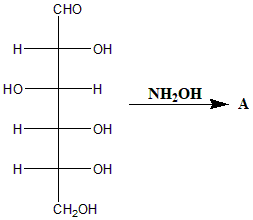
Product \('A'\) is:
Answer & explanation
Correct answer: option 1
The correct answer is Option (1) → glucose oxime
Glucose has a free aldehyde group at C-1 in its open-chain form. Like other aldehydes it reacts with hydroxylamine: the –\( \ce{NH2} \) group adds to the C=O group and water is lost, giving an oxime:
\( \ce{HOCH2(CHOH)4CHO + NH2OH -> HOCH2(CHOH)4CH=N-OH + H2O} \)
The four –CHOH– groups and the –\( \ce{CH2OH} \) group are not affected. This reaction (and the addition of HCN to give a cyanohydrin) shows that glucose contains a carbonyl group.
Why the other options are incorrect
Option (2) glucose cyanohydrin — Incorrect. A cyanohydrin (–CH(OH)CN) is formed by adding HCN to glucose, not hydroxylamine.
Option (3) the C-1 –CH2–NH–NH2 compound — Incorrect. Hydroxylamine condenses with C=O to give C=N–OH; it cannot give a C–N–N group, since no hydrazine is present.
Option (4) the C-1 –CH2–CN compound — Incorrect. A –CH2–CN group is not formed by any reaction with hydroxylamine; the C=N–OH of the oxime keeps its oxygen.
NCERT (2026-27 edition):
Structure of Glucose – …
