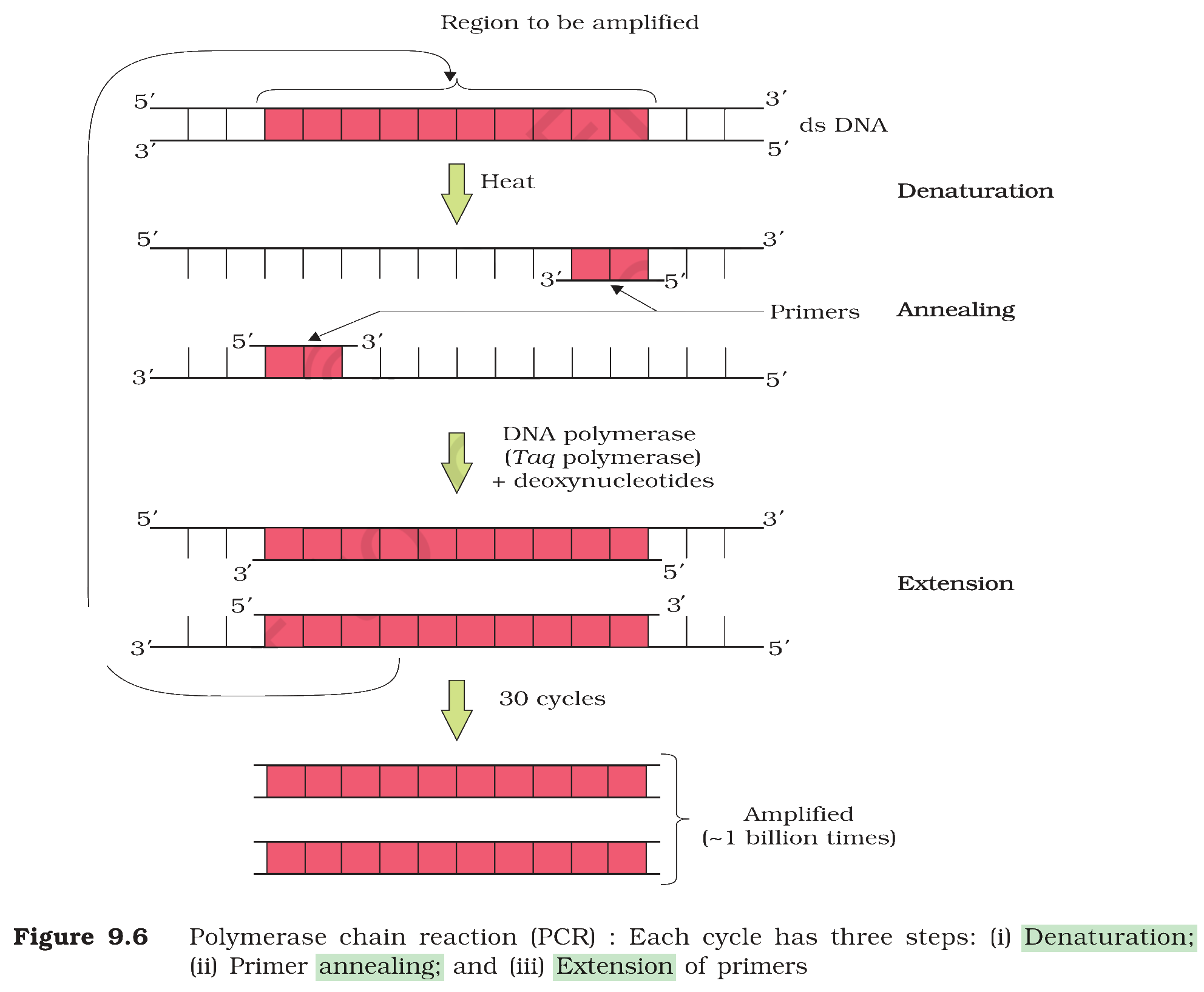
Arrange the given steps involved in Polymerase Chain Reaction.
(A) Annealing
(B) Extension
(C) Denaturation
(D) Amplification
Choose the correct answer from the options given below:
Answer & explanation
Correct answer: option 1
The correct answer is Option (1) → (C), (A), (B), (D)
(C) Denaturation — first. The double-stranded DNA is heated to a high temperature. The two strands separate, so each can act as a template.
(A) Annealing — second. The mixture is cooled. The two primers bind to their complementary regions on the single strands. Primers are short, chemically made pieces of DNA.
(B) Extension — third. The heat-stable DNA polymerase (Taq polymerase) adds nucleotides to the primers and copies the template strands.
(D) Amplification — last. Amplification is not a separate step of one cycle. It is the result of repeating the three steps many times (about 30 cycles). The DNA doubles in each cycle and reaches about a billion copies.
Note: The same question was also asked in CUET (UG) 2025 on 02-06-2025 (Slot 2), and a similar question in CUET (UG) 2023 on 15-06-2023 (Slot 1), on 12-06-2023 (Slot 2), on 07-06-2023 (Slot 3) and on 31-05-2023 (Slot 3).
NCERT Extract:
Amplification of Gene of Interest using PCR – “PCR stands for Polymerase Chain Reaction. In this reaction, multiple copies of the gene (or DNA) of interest is synthesised in vitro using two sets of primers (small chemically synthesised oligonucleotides that are complementary to the regions of DNA) and the enzyme DNA polymerase. The enzyme extends the primers using the nucleotides provided in the reaction and the genomic DNA as template. If the process of replication of DNA is repeated many times, the segment of DNA can be amplified to approximately billion times, i.e., 1 billion copies are made.”