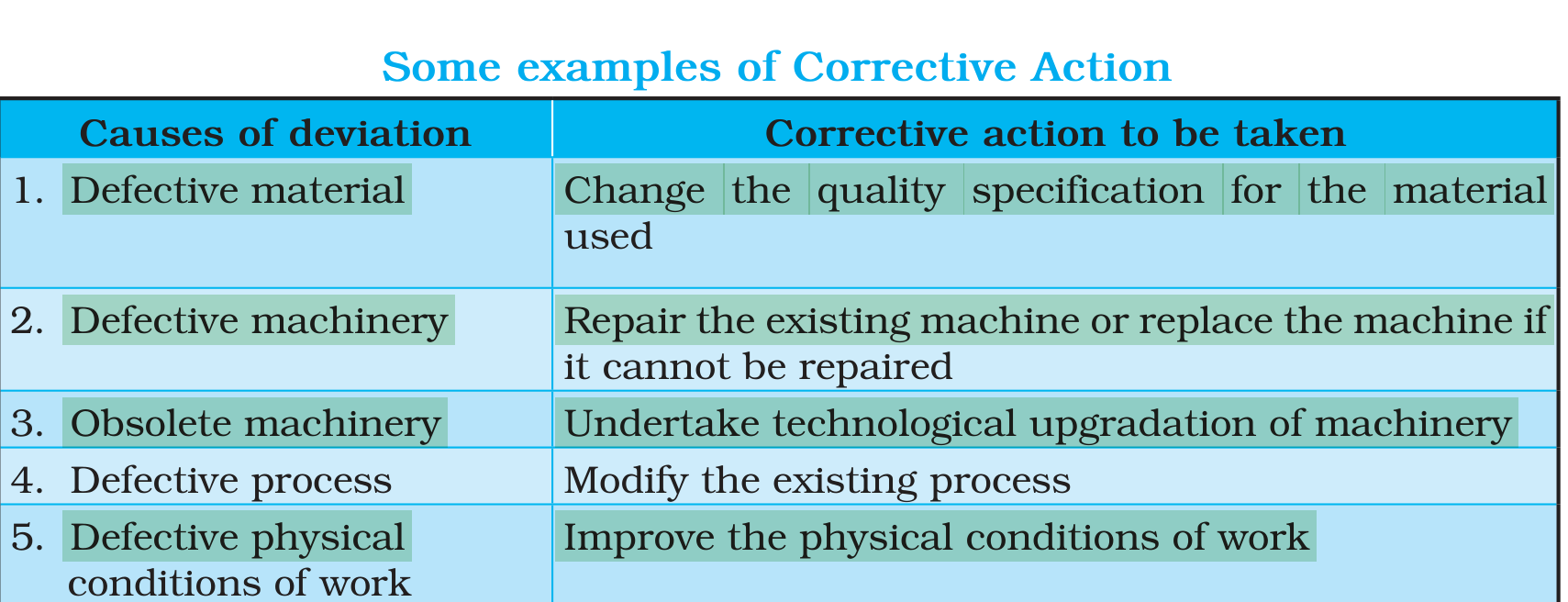
Identify the correct example(s) for "corrective action" that can be undertaken by the company during the controlling process.
(A) Improve the physical conditions of work, if working conditions are not good.
(B) Replace or repair the existing machines, in case of poor performance by the salesperson.
(C) Do not change the quality specifications for the material used, if the material is defective.
(D) Use outdated technology for producing the good, if it's advanced version is already available in the market.
Choose the correct answer from the options given below:
Answer & explanation
Correct answer: option 4
The correct answer is Option (4) → (A) only
(A) Improve the physical conditions of work, if working conditions are not good. — A correct example of corrective action (Correct). Poor working conditions are the cause of the poor work. Improving them removes that cause, so the action matches the cause.
(B) Replace or repair the existing machines, in case of poor performance by the salesperson. — Not a correct example (Incorrect). The action does not match the cause. Repairing or replacing a machine is the remedy for defective machinery. A salesperson’s poor performance has nothing to do with machines. It may need, for example, training.
(C) Do not change the quality specifications for the material used, if the material is defective. — Not a correct example (Incorrect). If the material is defective, its quality specification must be changed. Leaving it as it is lets the defect continue.
(D) Use outdated technology for producing the good, if it’s advanced version is already available in the market. — Not a correct example (Incorrect). Old machinery calls for an upgrade to the new technology. Keeping the outdated technology does not correct anything.
Note: The current NCERT book (2026-27) explains corrective action only in general words. The table of causes of deviation and the corrective action for each, on which this question is based, is in the pre-rationalised NCERT. Extracts from both books follow. NCERT (2026-27 Edition): “Step 4: Analysing Deviations: … It is necessary to identify the exact cause(s) of deviations, failing which, an appropriate corrective action might not be possible. The deviations and their causes are then reported and corrective action taken at appropriate level.” “Step 5: Taking Corrective Action: The final step in the controlling process is taking corrective action. No corrective action is required when the deviations are within acceptable limits. However, when the deviations go beyond the acceptable range, especially in the important areas, it demands immediate managerial attention so that deviations do not occur again and standards are accomplished.” “Corrective action might involve training of employees if the production target could not be met. Similarly, if an important project is running behind schedule, corrective action might involve assigning of additional workers and equipment to the project and permission for overtime work. …” NCERT (Pre-rationalised Edition):
|