The final product of the following reaction is

Answer & explanation
Correct answer: option 1
The correct answer is Option (1) → R-NH2
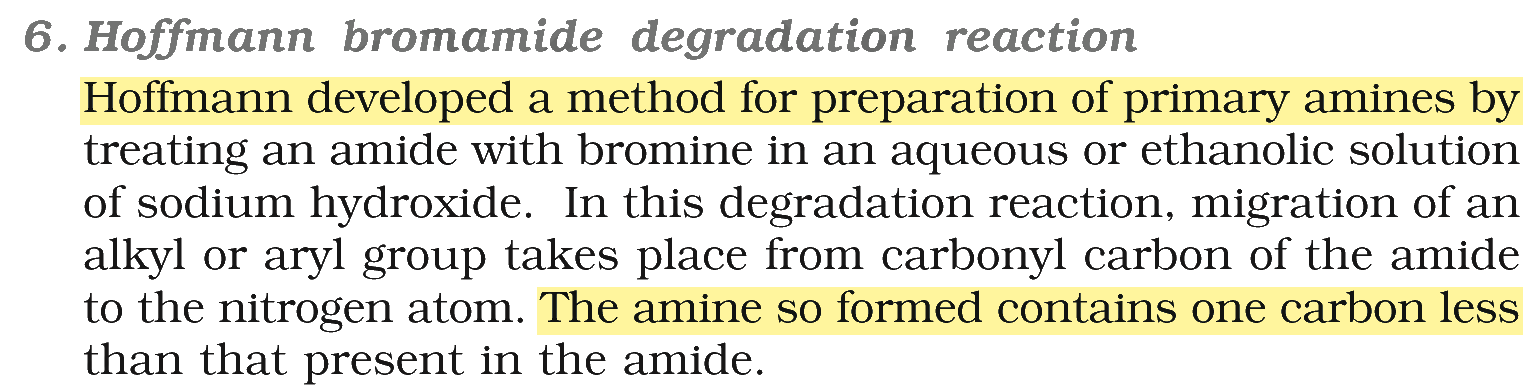
An amide heated with bromine and aqueous (or ethanolic) sodium hydroxide gives a primary amine. This is the Hofmann bromamide degradation:
\( \displaystyle \ce{R-CONH2 + Br2 + 4NaOH -> R-NH2 + Na2CO3 + 2NaBr + 2H2O} \)
During the reaction the alkyl group moves from the carbonyl carbon to the nitrogen atom, and the carbonyl carbon leaves as sodium carbonate. So the amine formed has one carbon atom fewer than the amide.
So the final product is R–NH2.
Why the other options are incorrect
Option (2) R-CH2-NH2 — Incorrect. This amine has the same number of carbon atoms as the amide. It is the product of reducing the amide with \( \ce{LiAlH4} \), not of the Hofmann reaction.
\( \displaystyle \ce{R-CONH2} \xrightarrow[\text{(ii) }\ce{H2O}]{\text{(i) }\ce{LiAlH4}} \ce{R-CH2-NH2} \)
Option (3) R-CO-NHBr — Incorrect. The N-bromoamide is only an intermediate; with excess alkali it goes on to give the amine.
Option (4) R-CO-Br — Incorrect. Bromine replaces a hydrogen on nitrogen, not the –\( \ce{NH2} \) group, so an acyl bromide is not formed.
NCERT (2026-27 edition):
Hofmann Bromamide Degradation Reaction