
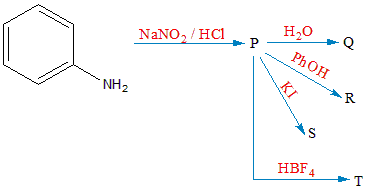
Predict P, Q, R, S, and T in the correct sequence
Answer & explanation
Correct answer: option 3
The correct answer is Option (3) → E, A, C, B, D
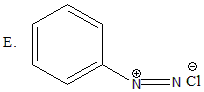
Aniline is diazotised by \( \ce{NaNO2} \)/HCl at 273–278 K:
\( \ce{C6H5NH2 + NaNO2 + 2HCl -> C6H5N2+Cl- + NaCl + 2H2O} \)
P = benzenediazonium chloride (E).
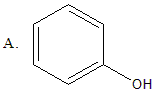
Q = phenol (A): warming the diazonium salt with water replaces –\( \ce{N2^{+}} \) by –OH. \( \ce{C6H5N2+Cl- + H2O -> C6H5OH + N2 + HCl} \)
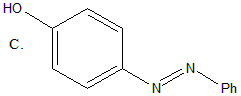
R = p-hydroxyazobenzene (C): coupling with phenol at its para position. \( \ce{C6H5N2+Cl- + C6H5OH} \xrightarrow{\ce{OH-}} \underset{\text{p-hydroxyazobenzene}}{\ce{HOC6H4N=NC6H5}} + \ce{HCl} \)
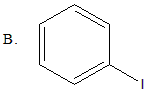
S = iodobenzene (B): \( \ce{C6H5N2+Cl- + KI -> C6H5I + KCl + N2} \)
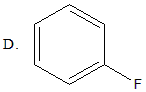
T = fluorobenzene (D): with \( \ce{HBF4} \) the diazonium fluoroborate precipitates and on heating gives the aryl fluoride. \( \ce{C6H5N2+BF4-} \xrightarrow{\Delta} \ce{C6H5F + BF3 + N2} \)
NCERT (2026-27 edition):
Chemical Reactions – “… Replacement by iodide ion: Iodine is not easily introduced into the benzene ring directly, but, when the diazonium salt solution is treated with potassium iodide, iodobenzene is formed.
Replacement by fluoride ion: When arenediazonium chloride is treated with fluoroboric acid, arene diazonium fluoroborate is precipitated which on heating decomposes to yield aryl fluoride.
Benzene diazonium chloride reacts with phenol in which the phenol molecule at its para position is coupled with the diazonium salt to form p-hydroxyazobenzene. This type of reaction is known as coupling reaction.”
Note: The same/similar question has been asked in different years by NTA as per the details given below:
| 2026 | 2025 | 2024 | 2023 | 2022 |
|---|---|---|---|---|
| – | – | – | 02-06 S3 31-05 S1 | – |