
A can do $\frac{4}{5}$ of a work in 20 days and B can do $\frac{3}{4}$ of the same work in 15 days. They work together for 10 days. C alone completes the remaining work in 1 day. B and C together can complete $\frac{3}{4}$ of the same work in:
Answer & explanation
Correct answer: option 2
A = \(\frac{4}{5}\)W = 20 days = 25 days,
B = \(\frac{3}{4}\)W = 15 days = 20 days,
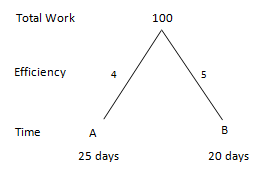
⇒ A + B worked for 10 days = (4 + 5) x 10 = 90 units. ..(Efficiency × Days = Total work)
⇒ Remaining work = 100 - 90 = 10 units.
⇒ C completed 10 units of work in 1 day, Therefore C = 10 (Efficiency)
⇒ \(\frac{3}{4}\) of total work = \(\frac{3}{4}\) x 100 = 75 units.
⇒ Time taken by B + C to complete 75 units of work = \(\frac{75}{5+10}\) = \(\frac{75}{15}\) = 5 days. ..(\(\frac{Work}{Efficiency}\) = Time)