A different sort of extended neighbourhood is encountered eastwards, where general trade is more evident alongside energy and military nuances, wrapped up evocation of historical and cultural links. India's look East Policy was formally announced in the early 1990s. Initially it was economics driven, emphasizing Southeast Asia and its regional organisation ASEAN. This is what Prime Minister Atal Behari Vajpayee had in mind in 2004: "I also naturally look at India's extended neighbourhood in South-East Asia. This is a region where truly historic socio-economic transformations are taking place. India became a Sectoral Dialogue Partner of ASEAN in 1992, a member of the ASEAN Regional Forum (ARF) in 1995, and full Dialogue Partner of ASEAN in 1996 . Annual summit meetings between India and ASEAN commenced in 2002.
Which founding member of the ASEAN is also a founding member of NAM?
Answer & explanation
Correct answer: option 2
The correct answer is Option (2) → Indonesia
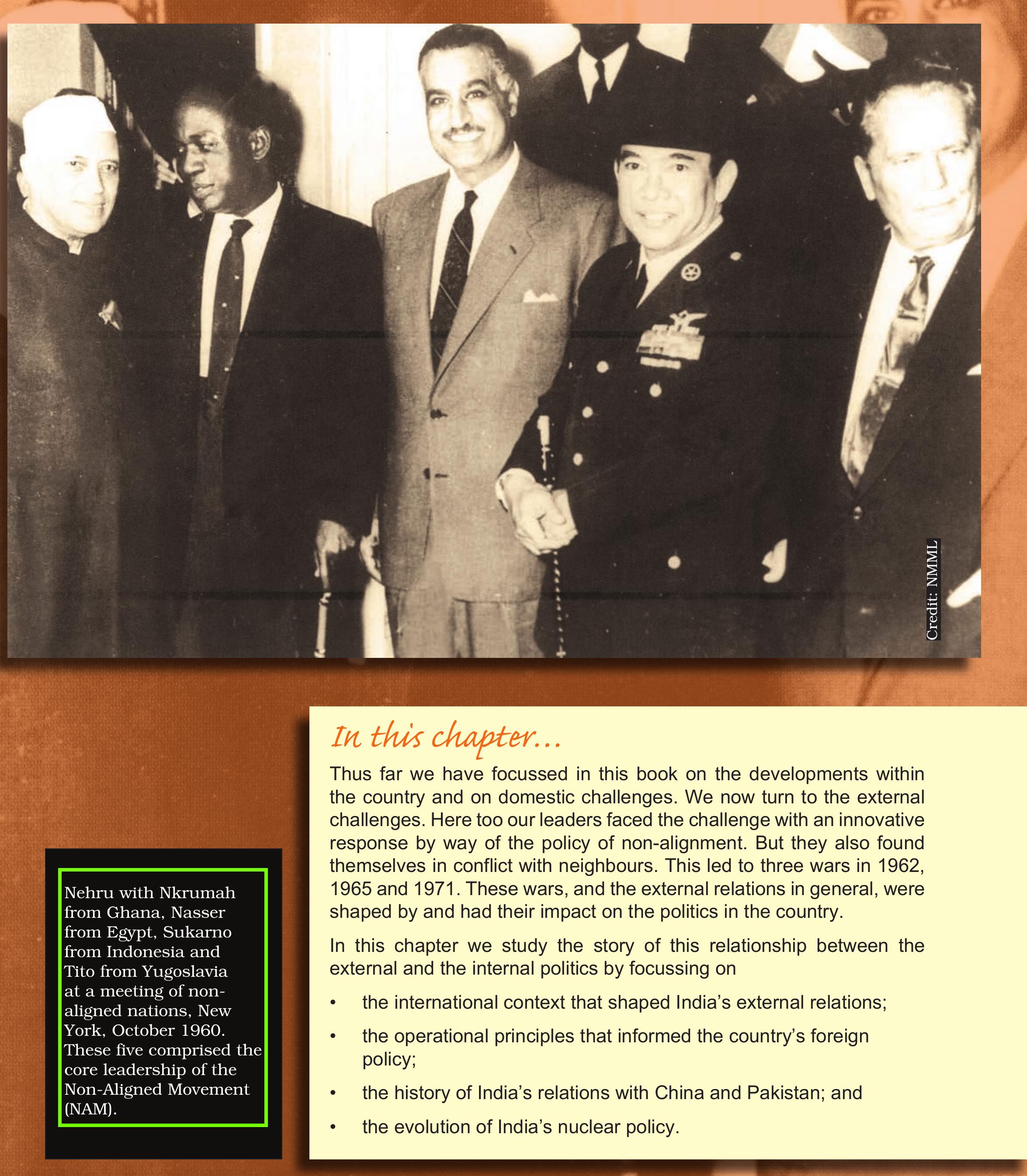
Indonesia was one of the five countries that established ASEAN in 1967, and its leader Sukarno, with Nehru, Nasser, Nkrumah and Tito, formed the core leadership of the Non-Aligned Movement (NAM).
The Philippines, Thailand and Malaysia were also founding members of ASEAN, but none of their leaders was among these five.
NCERT (2026-27): “Association of South East Asian Nations (ASEAN) … ASEAN was established in 1967 by five countries of this region — Indonesia, Malaysia, the Philippines, Singapore and Thailand — by signing the Bangkok Declaration.…” NCERT (2026-27): Politics in India since Independence — Chapter 4: India’s External Relations, opening photograph and its caption: Sukarno from Indonesia … These five comprised the core leadership of the Non-Aligned Movement (NAM)
|