CUETMOCK
  • Pricing
  • Mentors
Log inStart freeStart free mocks→

First test, then trust

Try a free CUET mock test.

Join 5,00,000+ students who rehearsed exam day on the exact NTA screen before sitting CUET. On the web and on Android.

Start free mocks →Get the Android app
CUETMOCK

India's #1 CUET Mock Test Platform. Original NCERT-based questions on the exact NTA exam screen — trusted by 5,00,000+ students since CUET 2022.

Get it onGoogle PlayScan to download the CUETMOCK app

Mock tests

  • CUET mock test series
  • Commerce mocks
  • Humanities (Arts) mocks
  • Science mocks
  • Languages & GAT mocks
  • Free practice questions
  • Pricing

Resources

  • CUET exam guide
  • CUET syllabus
  • Universities accepting CUET
  • Expert blogs
  • News & notifications
  • Webinars & counselling
  • CUET score calculator
  • How we estimate your rank
  • FAQs

Company

  • About us
  • Our leadership & team
  • Our toppers
  • Mentors
  • For schools
  • Contact us
  • Terms
  • Privacy
  • Refund policy

Talk to us

+91 7696 6630 56info@cuetmock.comWhatsApp us

Our other platforms

  • JEE Mock — For IIT-JEE aspirants
  • NEET Mock — For NEET aspirants

Newsletter

Exam updates, study material and offers — no spam.

© 2026 NYC Ventures Pvt. Ltd.

701-702, Royal Business Park, Zirakpur, Punjab - 140603

  • Terms of use
  • Privacy policy
  • Refund policy
  • Contact us

iCUETMOCK is an independent preparation platform, not affiliated with the National Testing Agency (NTA). Always check exam details on the official NTA website.

  • Home
  • Mock tests
  • CUET guide
  • Pricing
  • Log in
Home/Practice questions/Economics
EconomicsMacro Economics: Money and Banking

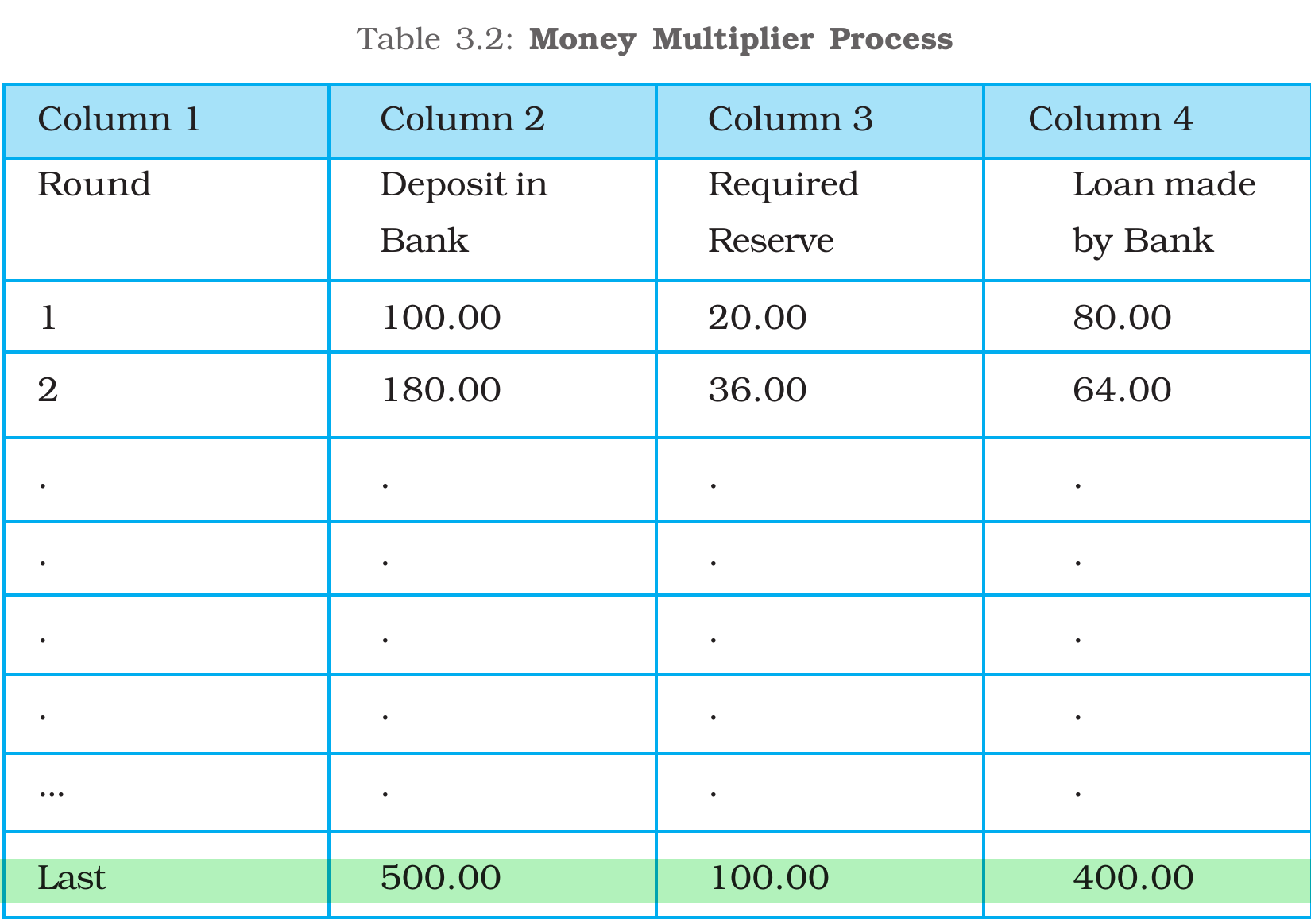
How much are the deposits created in the above example ?

Money Multiplier Process

Column 1Column 2Column 3Column 4
RoundDeposit in BankRequired ReserveLoan made by Bank
1100.0020.0080.00
2180.0036.0064.00
----
----
----
----
----
Last500.00100.00400.00

The first column lists each round. The second column depicts the total deposits with the Bank at the beginning of each round. Twenty percent of these deposits need to be deposited with the RBI as required reserves (column 3). What the Bank lends in each round gets added to the deposits with the bank in the next round. Column 4 indicates the Loans made by the banks.

How much are the deposits created in the above example ?

Answer & explanation+

Correct answer: option 4

The correct answer is Option (4) → 500.00

Column 2 gives the deposits with the bank. Each loan comes back to the bank as a new deposit, so this column keeps growing round after round. It stops at the last round, at 500.00.

At that point the required reserves are 100.00, which is 20 per cent of 500.00. The first deposit of 100.00 has now all gone into required reserves, so the bank cannot lend any more.

NCERT (2026-27): “3.3.2 Limits to Credit Creation and Money Multiplier … Let us assume that our bank starts with a deposit of Rs 100 made by Leela. The reserve ratio is 20 per cent. Thus our bank has Rs 80 (100 – 20) to lend and the bank lends out Rs 80 to Jaspal Kaur, which shows up in the bank’s deposits in the next round as liabilities, making a total of Rs 180 as deposits. Now our bank is required to keep 20 per cent of 180 i.e. Rs 36 as cash reserves. Recall that our bank had started with Rs 100 as cash. Since it is required to keep only Rs 36 as reserves, it can lend Rs 64 again (100 – 36 = 64). The bank lends out Rs 64 to Junaid. This in turn shows up in the bank as deposits. The process keeps repeating itself till all the required reserves become Rs 100. The required reserves will be Rs 100 only when the total deposits become Rs 500. This is because for deposits of Rs 500, cash reserves would have to be Rs 100 (20 per cent of 500 = 100).…”

NCERT extract

Advertisement

Practise more on Macro Economics: Money and Banking

Chapter-wise mocks on the real NTA exam screen, with solutions and your rank. Your first mocks are free.

Start free mocks →

Advertisement

Next questions

  1. A shop stocks x chairs and y tables. Match each condition in List-I with the inequality that expresses it in List-II. List-IList-II Conditi…Maths. Section B1 · Linear Programming
  2. The radii of two circular faces of a frustum of a cone are 12 cm and 9 cm. If the height of the frustum is 21 cm, find its volume. -General Aptitude Test · Quantitative Reasoning
  3. In a question, find the odd word from the given alternative.General Aptitude Test · General Ability
  4. Which candidate was supported by Smt. Indira Gandhi for the 1969 presidential elections?Political Science · Politics in India Since Independence: Challenges to and Restoration of the Congress System
  5. A number arrangement machine, when given an input line of numbers, rearranges them step by step following a particular rule. An illustratio…General Aptitude Test · Verbal Reasoning
  6. उपरोक्त गद्यांश के अनुसार श्रीनिवासजी का पेशा क्या था?Hindi · Comprehension - (Narrative / Factual)
  7. What is NOT an undesirable effects in the course of signal transmission?Physics · Communication
  8. The population of a city increases 5% annually in compounded manner (yearly compounding). The present population of this city is 93051. The…General Aptitude Test · Numerical Ability
  9. निम्नलिखित में से कौन-सा रात का पर्यायवाची नहीं है?Hindi · Synonyms
  10. Match list I with list II.List-IType of unit cellList-IINumber of lattice pointsA. Primitive unit cellI. 9B. Body centred unit cellII. 8C.…Chemistry · Physical: Solid State