Match list I with list II.
| List-I Type of unit cell | List-II Number of lattice points |
| A. Primitive unit cell | I. 9 |
| B. Body centred unit cell | II. 8 |
| C. Face centred unit cell | III. 10 |
| D. End centred unit cell | IV. 14 |
Choose the correct answer from the option given below.
Answer & explanation
Correct answer: option 2
The correct answer is Option (2) → A-II, B-I, C-IV, D-III
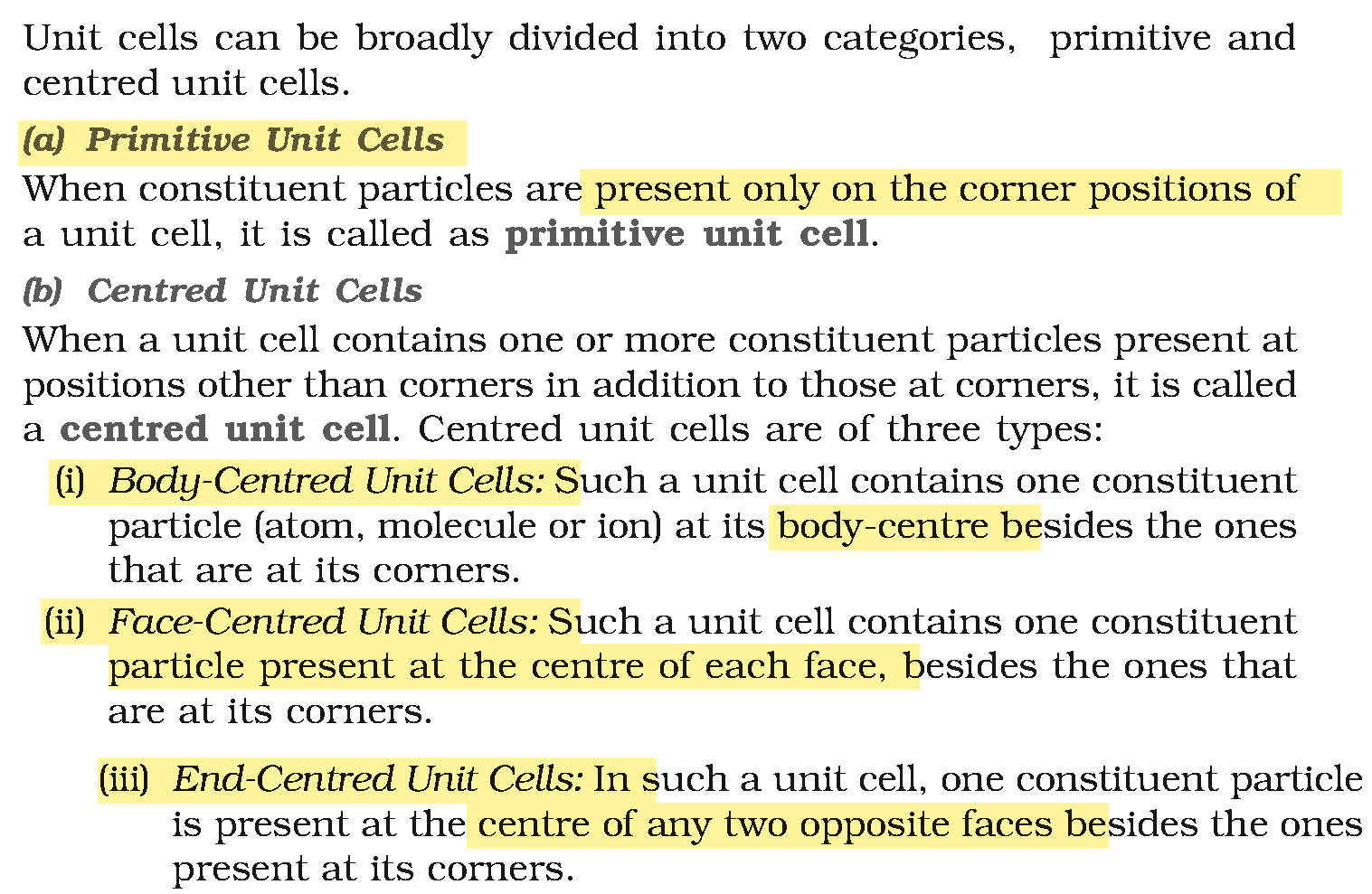
A unit cell is primitive when lattice points sit only at its 8 corners. A centred unit cell has extra lattice points: one at the body centre (body-centred), one at the centre of each of the 6 faces (face-centred), or one at the centre of each of two opposite faces (end-centred). Counting every lattice point drawn in the unit cell:
A. Primitive unit cell — This matches II. 8. Only the 8 corners carry lattice points.
\( 8 \)
B. Body centred unit cell — This matches I. 9. The 8 corners and 1 body centre.
\( 8 + 1 = 9 \)
C. Face centred unit cell — This matches IV. 14. The 8 corners and the 6 face centres.
\( 8 + 6 = 14 \)
D. End centred unit cell — This matches III. 10. The 8 corners and the centres of 2 opposite faces.
\( 8 + 2 = 10 \)
Shortcut: The pair A-II appears in Options (1) and (2), and B-I then leaves only Option (2).
Note: This question is from the pre-rationalised NCERT book (2022-23). The topic is not there in the latest NCERT book (2026-27), and it is also out of the CUET 2026 syllabus.
NCERT (Pre-rationalised edition, 2022-23):
Primitive and Centred Unit Cells