
X # Y means X is the father of Y;
X * Y means X is the brother of Y;
X $ Y means X is the daughter of Y;
X @ Y means X is the son of Y.
Which of the following expressions means 'A is the grand-daughter of K'?
Answer & explanation
Correct answer: option 3
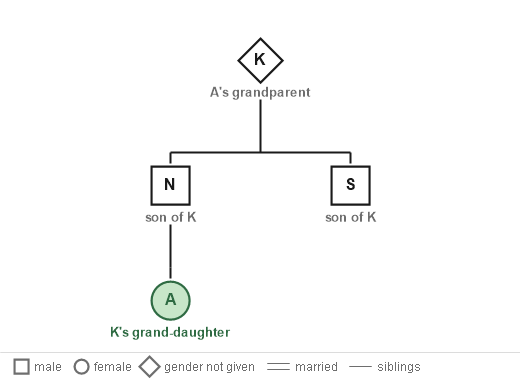
The correct answer is Option (3) → A $ N * S @ K
In a coded relation, each symbol stands for one relation. Each expression is broken into pairs of letters joined by a symbol, and each pair is read as “the letter on the left is the … of the letter on the right”.
The codes given in the question:
X # Y means X is the father of Y
X * Y means X is the brother of Y
X $ Y means X is the daughter of Y
X @ Y means X is the son of Y
A grand-daughter is a daughter of one’s son or daughter, so the expression must make A the daughter of a child of K. Option (3) breaks into three pairs:
A $ N — $ means “is the daughter of”. So A is the daughter of N; this pair also fixes A as female.
N * S — * means “is the brother of”. So N is the brother of S.
S @ K — @ means “is the son of”. So S is the son of K, and N, the brother of S, is also a son of K.
A is the daughter of K’s son N, so A is the grand-daughter of K.
Why the other options are incorrect
Option (1) A $ N * S # K — Incorrect. S is the father of K and N is S’s brother, so N is K’s uncle and A, N’s daughter, is K’s cousin.
Option (2) A $ N # S @ K — Incorrect. N is the father of S and S is the son of K, so N and K are S’s parents; A, N’s daughter, is then one generation below K, not two.
Option (4) A @ N * S $ K — Incorrect. A @ N means A is the son of N, so A is K’s grandson, not grand-daughter.
Tip: In a question on a grand-daughter or a grandson, look first at the symbol right after A: it alone fixes A’s gender. Here @ rules out Option (4) at once.