Read the passage carefully and answer the questions.
Electrochemistry is the study involving two types of processes. One type involves the production of electricity from the energy released during a spontaneous chemical reaction. Galvanic cells like Daniel cells are used to produce electricity from the redox reaction. Nernst equation of a galvanic cell gives the relation between the standard cell potential and the concentration of the species involved in the redox reaction. The second type of study involves the cells in which electrical energy is used to bring about the chemical reactions in a non-spontaneous process. The conductance of electrolytic solution depends on many factors including the nature of the electrolyte and the dimensions of the electrolytic cell.
The following equation represents the reaction taking place in a Galvanic cell:
\( Mg(s) + 2Ag^+ (0.001M) → Mg^{2+}(0.01M) + 2Ag (s) \)
Calculate its \( E_{cell} \) at 298 K if \( E^0_{cell} = 2.91 V \)
Answer & explanation
Correct answer: option 1
The correct answer is Option (1) → 2.79 V
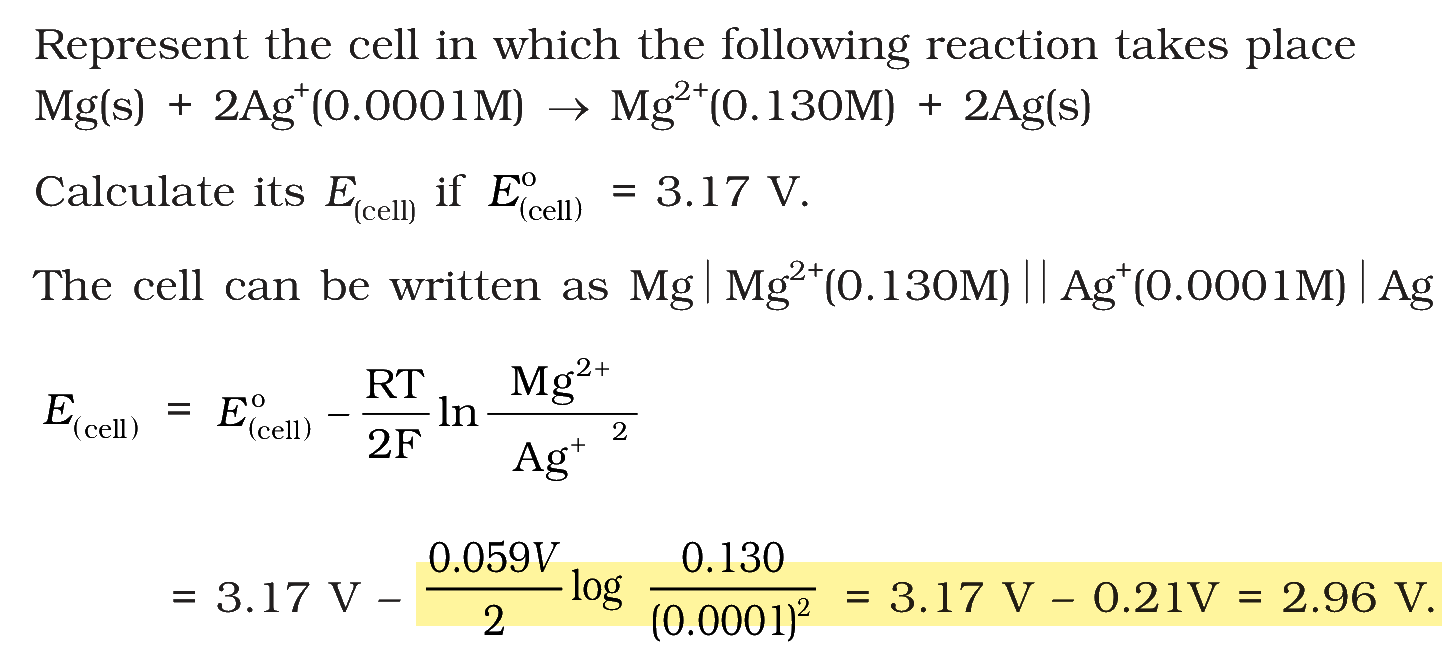
The Nernst equation gives the emf of a cell when the ions are not at 1 M. At 298 K:
\( \displaystyle E_{cell} = E^{\circ}_{cell} - \frac{0.059}{n}\log Q \)
where n is the number of electrons transferred and Q is the reaction quotient (solids are left out). The two half-reactions are:
\( \displaystyle \text{Anode: } \ce{Mg(s) -> Mg^2+(aq) + 2e^-} \)
\( \displaystyle \text{Cathode: } \ce{2Ag+(aq) + 2e^- -> 2Ag(s)} \)
So n = 2, and
\( \displaystyle Q = \frac{[\ce{Mg^2+}]}{[\ce{Ag+}]^{2}} = \frac{0.01}{(0.001)^{2}} = \frac{10^{-2}}{10^{-6}} = 10^{4} \)
Substituting:
\( \displaystyle E_{cell} = 2.91 - \frac{0.059}{2}\log 10^{4} \)
\( \displaystyle E_{cell} = 2.91 - 0.0295 \times 4 = 2.91 - 0.118 \)
\( \displaystyle E_{cell} = 2.79\ \mathrm{V} \)
So the emf of the cell is 2.79 V.
Note: NTA picked this question from an NCERT (2026-27) example and changed the figures. Do not ignore NCERT while practising numericals.
NCERT (2026-27 edition):
Nernst Equation – …