Read the passage carefully and answer the questions based on the passage:
FLOOR PRICES
For certain goods and services, fall in price below a particular level is not desirable and hence the government sets floors or minimum prices for these goods and services. The government imposed lower limit on the price that may be charged for a particular good or service is called price floor. Most well-known examples of imposition of price floor are agricultural price support programmes and the minimum wage legislation. Through an agricultural price support programme, the government imposes a lower limit on the purchase price for some of the agricultural goods. Similarly, through the minimum wage legislation, the government ensures that the wage rate of the labourers does not fall below a particular level.
Imposition of price floors usually lead to following ____.
Answer & explanation
Correct answer: option 2
The correct answer is Option (2) → Excess supply.
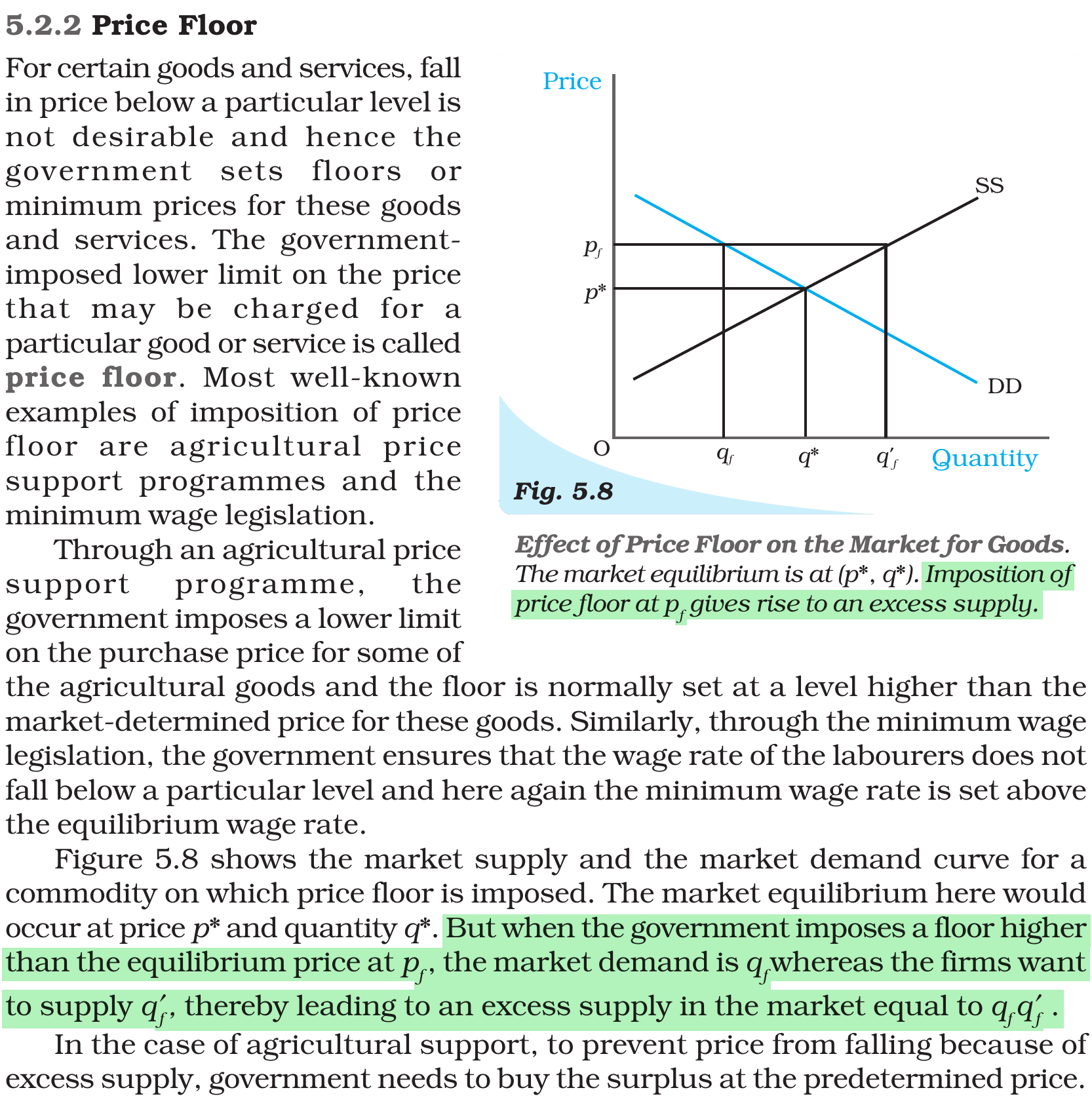
A price floor is normally set above the market-determined price. At this higher price, consumers buy less and firms want to sell more. So market supply is greater than market demand, which is excess supply.
Option (1) Excess demand. — Incorrect. Excess demand means that market demand is greater than market supply. It comes from a price ceiling, a maximum price set below the market price.
Option (2) Excess supply. — Correct. At the floor price, the quantity supplied is greater than the quantity demanded.
Option (3) Shortage of goods in the market. — Incorrect. A shortage is another name for excess demand. A price floor leaves more goods than buyers want.
Option (4) Determination of market equilibrium. — Incorrect. Equilibrium is the price at which market demand equals market supply. The floor keeps the price away from this level.
Note: The passage of this question is taken from the section ‘Price Floor’ of the chapter ‘Market Equilibrium’ of the NCERT book (Introductory Microeconomics). Read the applications at the end of a chapter too; this short section gave five questions.
NCERT (2026-27): Introductory Microeconomics — Chapter 5: Market Equilibrium
|