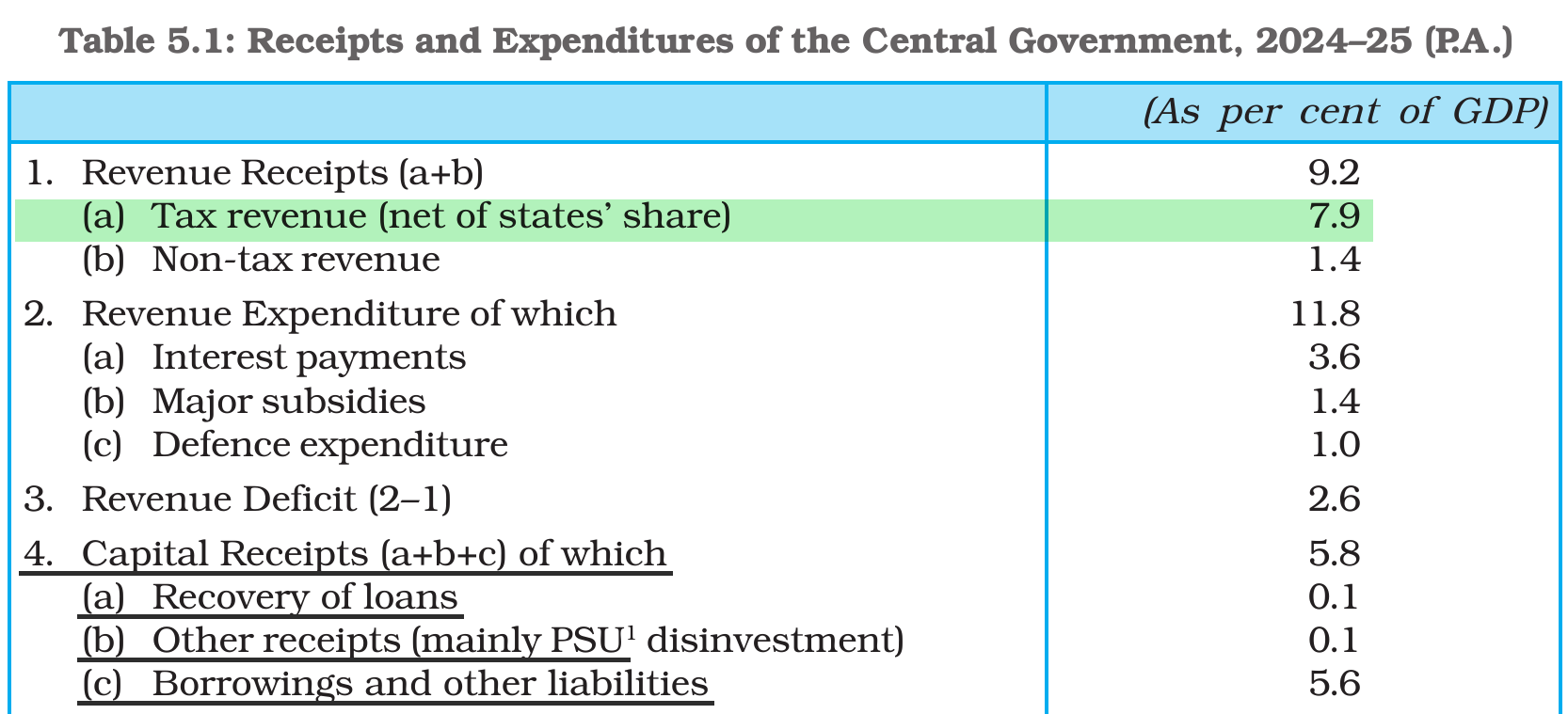
Which one is not the component of capital receipts?
Answer & explanation
Correct answer: option 1
The correct answer is Option (1) → Tax Revenue.
Tax revenue is a revenue receipt, since it does not lead to a claim on the government. A capital receipt either creates a liability for the government or reduces its assets.
Option (1) Tax Revenue. — Revenue receipt (Correct). Taxes do not have to be repaid. They create no liability, and the government gives up no asset.
Option (2) Recovery of Loans. — Capital receipt (Incorrect). A loan given by the government comes back, so its financial assets fall. This receipt does not create debt.
Option (3) Public Sector Undertaking Disinvestment. — Capital receipt (Incorrect). The government sells its shares in public sector undertakings (PSUs), so its financial assets fall.
Option (4) Borrowings and Other Liabilities. — Capital receipt (Incorrect). Loans must be returned to those who gave them, so they create a liability.
NCERT (2026-27): “5.1.2 Classification of Receipts … Revenue Receipts: Revenue receipts are those receipts that do not lead to a claim on the government. They are therefore termed non-redeemable. They are divided into tax and non-tax revenues.… …Capital Receipts: The government also receives money by way of loans or from the sale of its assets. Loans will have to be returned to the agencies from which they have been borrowed. Thus they create liability. Sale of government assets, like sale of shares in Public Sector Undertakings (PSUs) which is referred to as PSU disinvestment, reduce the total amount of financial assets of the government. All those receipts of the government which create liability or reduce financial assets are termed as capital receipts. When government takes fresh loans it will mean that in future these loans will have to be returned and interest will have to be paid on these loans. Similarly, when government sells an asset, then it means that in future its earnings from that asset, will disappear. Thus, these receipts can be debt creating or non-debt creating.…”
|