Arrange the sequence of events as they occurred in the experiment relating to "Telling a Lie for Twenty Dollars":
(A) The responses showed that the $1 group described the experiment as more interesting than the $20 group students
(B) Students participated in a very boring experiment
(C) Students were asked to tell another group of students waiting outside that the experiment was very interesting
(D) For telling the lie, half of the group was given $1 and the other half $20
(E) After some weeks, the participants of the boring experiment were asked to recall how interesting the experiment was
Choose the correct answer from the options given below:
Answer & explanation
Correct answer: option 4
The correct answer is Option (4) → (B), (C), (D), (E), (A)
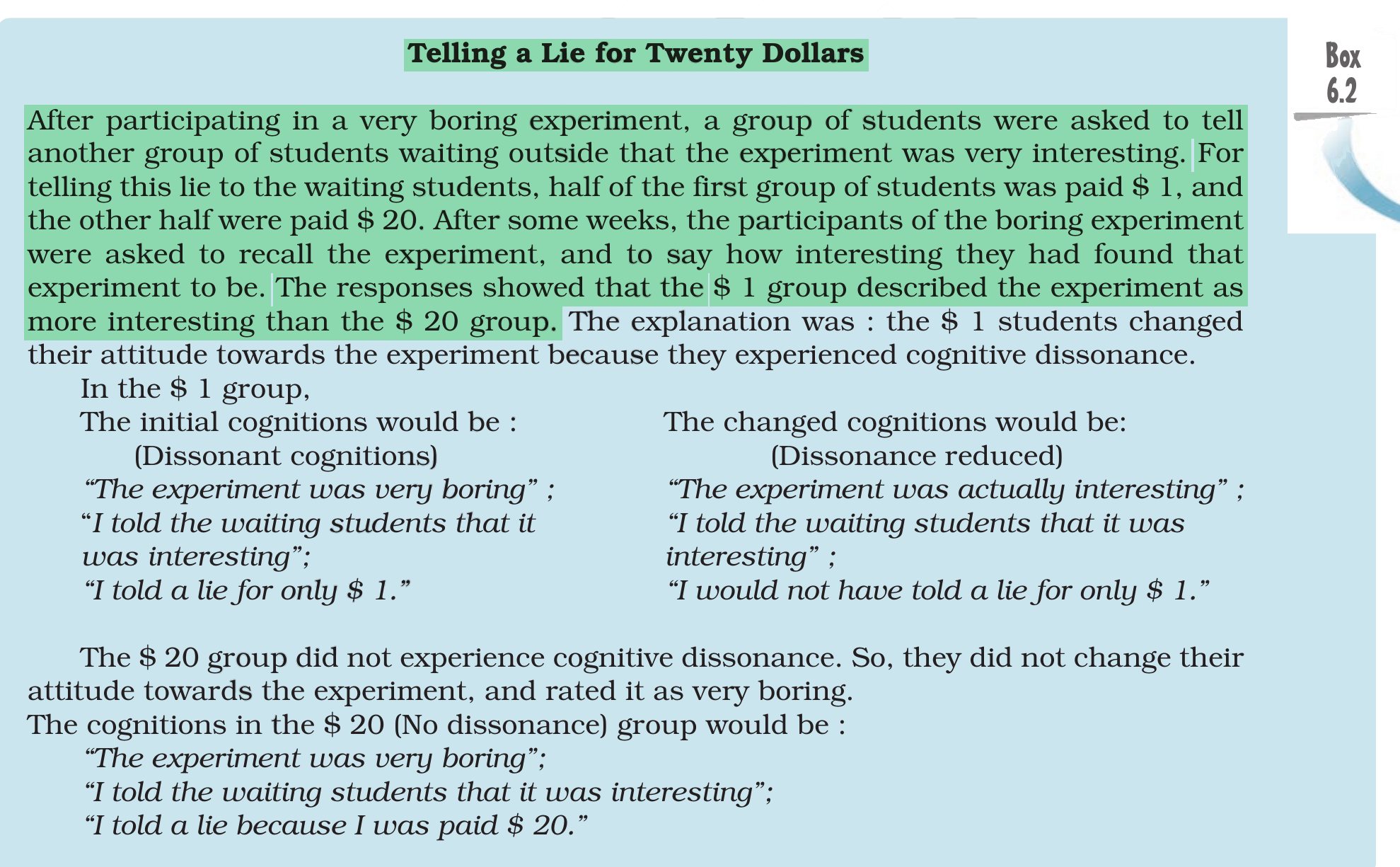
The experiment by Festinger and Carlsmith showed how cognitive dissonance changes an attitude.
(B) Students participated in a very boring experiment — first. Every student first went through a dull task, so all of them began by finding it boring.
(C) Students were asked to tell another group of students waiting outside that the experiment was very interesting — second. They were then asked to tell a lie to the next group.
(D) For telling the lie, half of the group was given $1 and the other half $20 — third. The payment for the lie was the one thing that differed between the two halves.
(E) After some weeks, the participants of the boring experiment were asked to recall how interesting the experiment was — fourth. Their attitude towards the task was measured later.
(A) The responses showed that the $1 group described the experiment as more interesting than the $20 group students — last, the result. The $1 students felt dissonance between ‘the experiment was boring’ and ‘I told a lie for only $1’, so they changed their attitude and found the task interesting. The $20 students had a good reason for the lie, felt no dissonance and still rated it boring.
NCERT (2025-26): “Attitude Change …Festinger and Carlsmith, two social psychologists, conducted an experiment that showed how cognitive dissonance works (see Box 6.2).…”
|