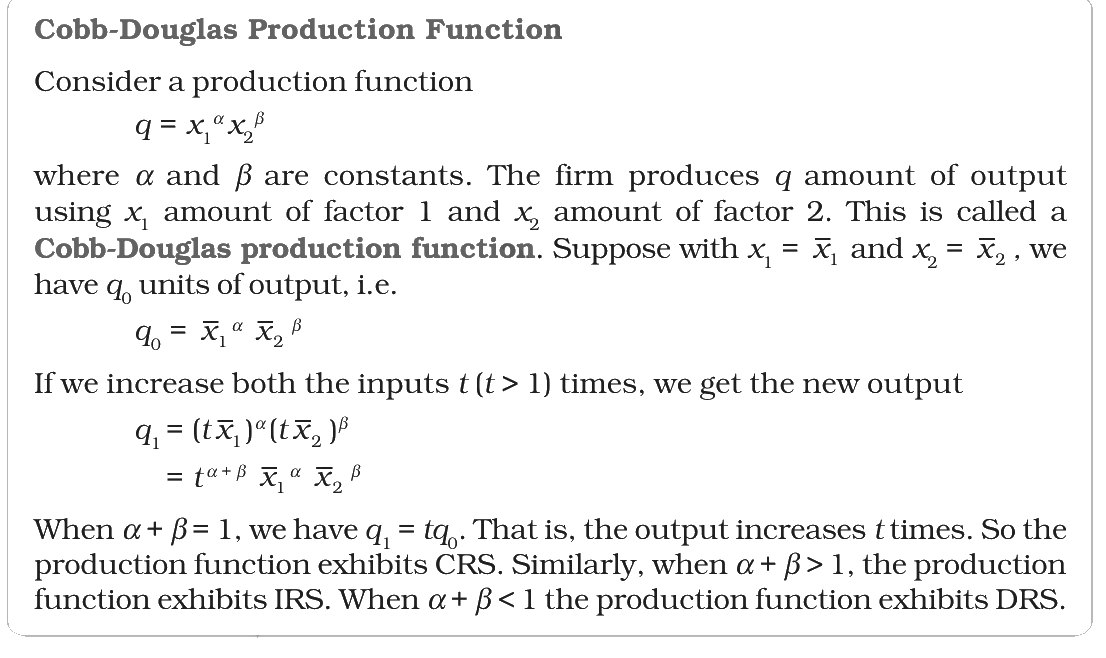
Consider the following statements about the Cobb-Douglas production function q = x1α x2β:
(A) α and β are constants.
(B) If both inputs are increased t times (t > 1), output becomes tα + β times the old output.
(C) When α + β = 1, the production function exhibits constant returns to scale.
(D) When α + β < 1, the production function exhibits increasing returns to scale.
(E) Its returns to scale are found by increasing x1 while x2 is held fixed.
Choose the correct answer from the options given below:
Answer & explanation
Correct answer: option 4
The correct answer is Option (4) → (A), (B) and (C) only
In q = x1αx2β, raising both inputs t times multiplies output by tα + β. So the sum α + β decides the returns to scale.
(A) α and β are constants. — Correct. α and β are fixed numbers that do not change with the inputs.
(B) If both inputs are increased t times (t > 1), output becomes tα + β times the old output. — Correct. (tx1)α(tx2)β = tα + βx1αx2β.
(C) When α + β = 1, the production function exhibits constant returns to scale. — Correct. Output then rises t times, the same as the inputs.
(D) When α + β < 1, the production function exhibits increasing returns to scale. — Incorrect. When α + β < 1, output rises by less than t times, so the function shows decreasing returns to scale.
(E) Its returns to scale are found by increasing x1 while x2 is held fixed. — Incorrect. Returns to scale need both inputs raised in the same proportion. Raising x1 alone with x2 fixed is the short run case of variable proportions.
NCERT (2026-27): “Cobb-Douglas Production Function … When α + β = 1, we have q1 = tq0. That is, the output increases t times. So the production function exhibits CRS. Similarly, when α + β > 1, the production function exhibits IRS. When α + β < 1 the production function exhibits DRS.”
“3.6 Returns to Scale … One special case in the long run occurs when both factors are increased by the same proportion, or factors are scaled up. …” |