
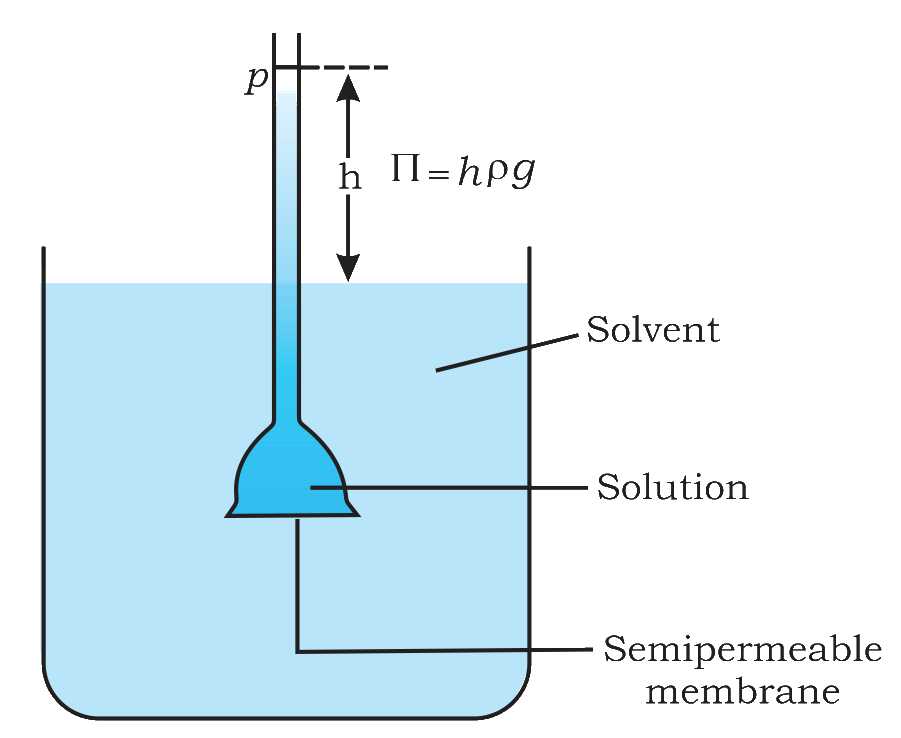
The figure shows a set-up in which, after some time, the level of the liquid in the tube of the funnel rises to a height h.
Which of the following explains the rise of the liquid level in the funnel tube?
Answer & explanation
Correct answer: option 3
The correct answer is Option (3) → Solvent molecules pass through the semipermeable membrane from the beaker into the funnel.
A semipermeable membrane has very small pores: small solvent molecules can pass through them, but the passage of bigger solute particles is hindered. Solvent then flows through the membrane from the pure solvent into the solution.
Reading the figure — the beaker holds the solvent and the funnel holds the solution, with the membrane fixed over the mouth of the funnel between them.
Direction of flow — from the beaker into the funnel. Solvent molecules enter the funnel, so the liquid in it increases and the level in its tube rises to the height h.
Why the other options are incorrect
Option (1) Solute particles pass through the semipermeable membrane from the funnel into the beaker. — Incorrect. The membrane hinders the passage of the bigger solute particles. A loss of particles from the funnel would also not make its level rise.
Option (2) Solvent molecules pass through the semipermeable membrane from the funnel into the beaker. — Incorrect. Solvent flows from the pure solvent to the solution, not the other way. A flow out of the funnel would make the level in its tube fall.
Option (4) Solute particles pass through the semipermeable membrane from the beaker into the funnel. — Incorrect. The beaker holds the pure solvent, so it has no solute particles to pass, and the membrane hinders solute particles in any case.
NCERT (2026-27 edition):
1.6.4 Osmosis and Osmotic Pressure – “…yet they contain a network of submicroscopic holes or pores. Small solvent molecules, like water, can pass through these holes but the passage of bigger molecules like solute is hindered. Membranes having this kind of properties are known as semipermeable membranes (SPM).”
“Assume that only solvent molecules can pass through these semi- permeable membranes. If this membrane is placed between the solvent and solution as shown in Fig. 1.9, the solvent molecules will flow through the membrane from pure solvent to the solution. This process of flow of the solvent is called osmosis.”
Fig. 1.9: Level of solution rises in the thistle funnel due to osmosis of solvent.