What is the Werner secondary valence in complex \( [CoCl(NH_3)_5]^{2+} 2Cl^- \)?
Answer & explanation
Correct answer: option 4
The correct answer is Option (4) → 6
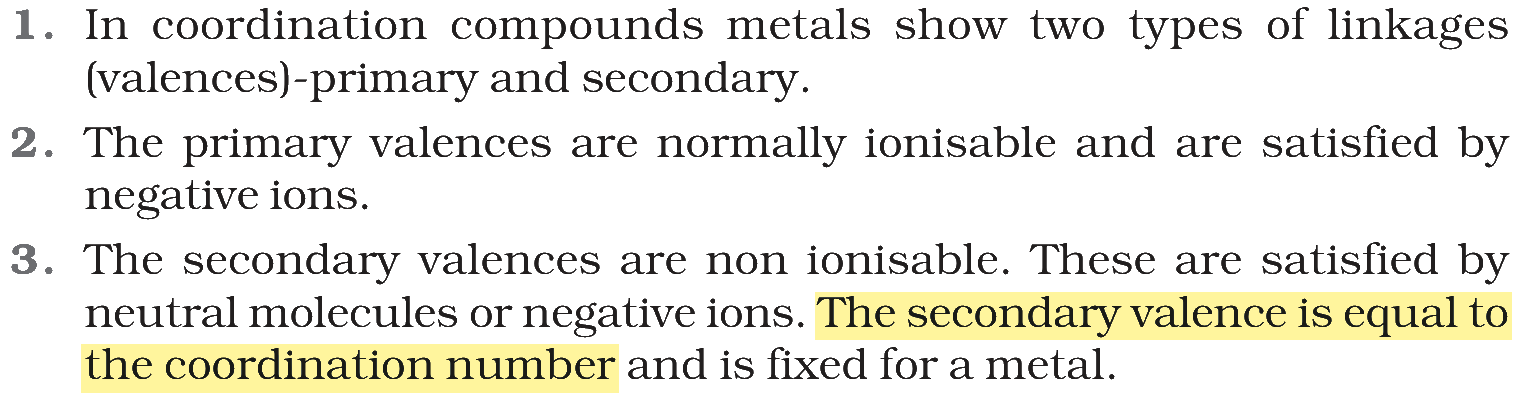
Werner proposed that a metal ion in a coordination compound shows two kinds of valence. The primary valence is ionisable, equals the oxidation state, and is satisfied by negative ions outside the coordination sphere. The secondary valence is non-ionisable; it is the number of groups bound directly to the metal, that is, the coordination number, and is satisfied by neutral molecules or negative ions.
In \( \ce{[CoCl(NH3)5]^2+ 2Cl-} \) the groups inside the square bracket are bound directly to cobalt: one \( \ce{Cl-} \) and five \( \ce{NH3} \) molecules.
\( \displaystyle \text{secondary valence} = 1\ (\ce{Cl-}) + 5\ (\ce{NH3}) = 6 \)
The primary valence of cobalt is 3 (\( \ce{Co^{3+}} \)). The coordinated chloride satisfies one secondary valence and also one of the three primary valences; the other two primary valences are the ionisable chlorides outside the bracket. So the secondary valence is 6.
NCERT (2026-27 edition):
Werner’s Theory of Coordination Compounds – …