
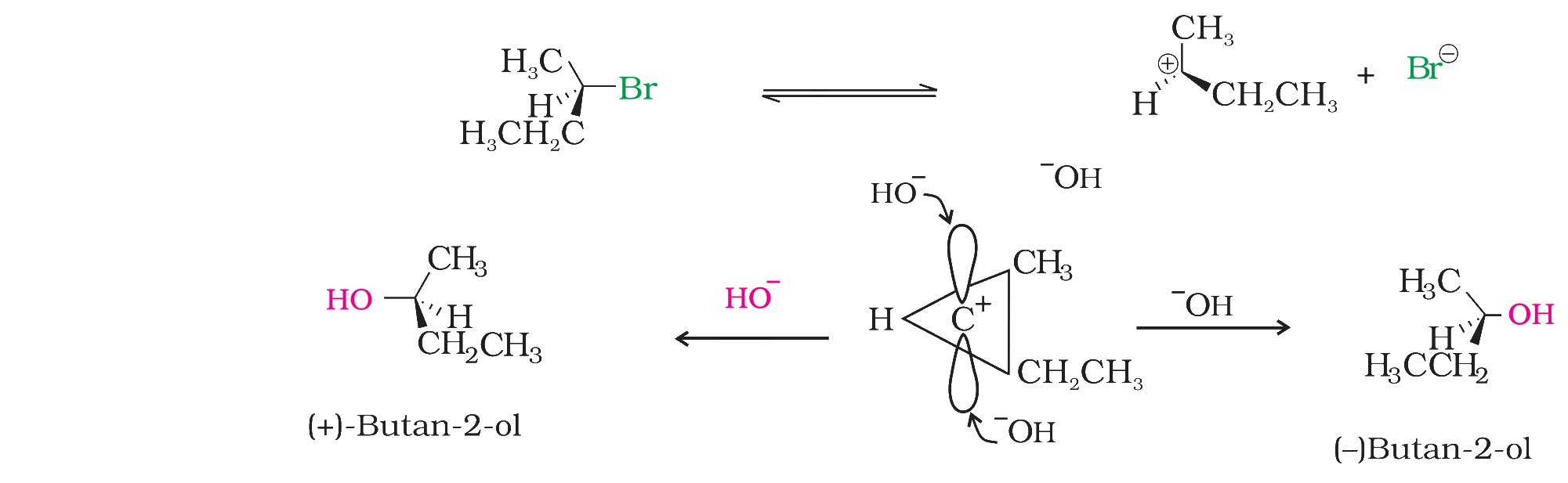
The scheme shows the hydrolysis of optically active 2-bromobutane by hydroxide ion through the SN1 mechanism.
Which step of the scheme is the slow step that decides the rate of the reaction?
Answer & explanation
Correct answer: option 1
The correct answer is Option (1) → The breaking of the C–Br bond of 2-bromobutane to form the carbocation and bromide ion
An SN1 reaction takes place in two steps, and the slower step decides the rate.
In the top row of the scheme (reversible arrows), the polarised C–Br bond breaks and gives the planar carbocation and Br–; this bond-breaking step is the slowest step, and it is reversible.
In the bottom row, OH– attacks the carbocation quickly from either face and gives (+)- and (–)-butan-2-ol.
Why the other options are incorrect
Option (2) The attack of the hydroxide ion on the carbocation to form butan-2-ol — Incorrect. The carbocation, once formed, is attacked quickly; this is the fast step II.
Option (3) A single step in which the C–O bond forms while the C–Br bond breaks — Incorrect. A single concerted step belongs to the SN2 mechanism; the scheme shows a carbocation formed between two steps.
Option (4) The combination of the carbocation with the bromide ion to form 2-bromobutane again — Incorrect. This is only the reverse of step I; it does not lead to the product.
NCERT (2026-27 edition):
6.7.1 Reactions of Haloalkanes – “It occurs in two steps. In step I, the polarised C—Br bond undergoes slow cleavage to produce a carbocation and a bromide ion. The carbocation thus formed is then attacked by nucleophile in step II to complete the substitution reaction.”
“Step I is the slowest and reversible. … Since the rate of reaction depends upon the slowest step, the rate of reaction depends only on the concentration of alkyl halide and not on the concentration of hydroxide ion.”
Scheme from section 6.7.1: hydrolysis of optically active 2-bromobutane by the SN1 mechanism