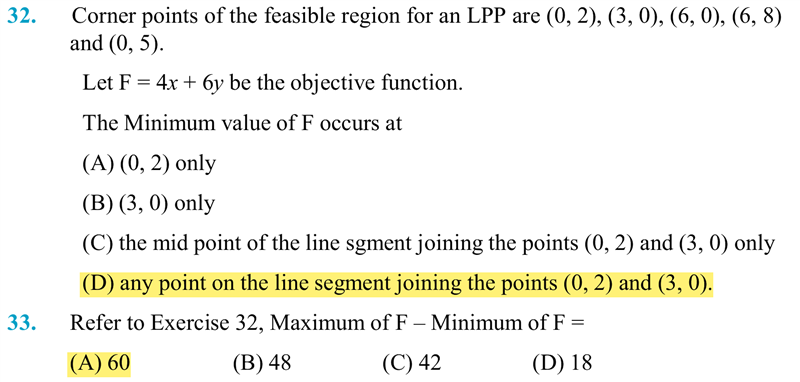
If the corner points of the bounded feasible region for a linear programming problem (LPP) are (0, 2), (3, 0), (6, 0), (6, 8) and (0, 5), then which of the following are correct for the objective function \(Z = 4x + 6y\)?
(A) The minimum value of the objective function occurs at (0, 2) and (3, 0) only.
(B) The minimum value of the objective function occurs at the mid-point of the line segment joining the points (0, 2) and (3, 0) only.
(C) The minimum value of the objective function occurs at every point of the line segment joining the points (0, 2) and (3, 0).
(D) The difference between the maximum value and minimum value of the objective function is 60.
Choose the correct answer from the options given below:
Answer & explanation
Correct answer: option 4
The correct answer is Option (4) → (C) and (D) only
Values of \(Z = 4x + 6y\) at the corner points:
\(Z(0, 2) = 12\)
\(Z(3, 0) = 12\)
\(Z(6, 0) = 24\)
\(Z(6, 8) = 24 + 48 = 72\)
\(Z(0, 5) = 30\)
The minimum, 12, occurs at two adjacent corners, (0, 2) and (3, 0). The maximum is 72, at (6, 8).
When the minimum occurs at two adjacent corner points, it occurs at every point of the segment joining them. Here that segment lies on \(2x + 3y = 6\), and on it
\(Z = 4x + 6y = 2(2x + 3y) = 12\)
So the minimum 12 occurs at every point of the segment joining (0, 2) and (3, 0), and the maximum is 72, at (6, 8).
Checking the statements
(A) The minimum value of the objective function occurs at (0, 2) and (3, 0) only. — Incorrect. It occurs at every point between them as well.
(B) The minimum value of the objective function occurs at the mid-point of the line segment joining the points (0, 2) and (3, 0) only. — Incorrect. The mid-point (1.5, 1) gives \(Z = 6 + 6 = 12\), but it is not the only such point.
(C) The minimum value of the objective function occurs at every point of the line segment joining the points (0, 2) and (3, 0). — Correct. On this segment \(Z = 2(2x + 3y) = 2 \times 6 = 12\).
(D) The difference between the maximum value and minimum value of the objective function is 60. — Correct. \(72 - 12 = 60\).
NCERT Exemplar:
Linear Programming