Match List-I with List-II.
| List-I (Coordination entity) | List-II (Colour of the coordination entity) |
|---|---|
| (A) \( \ce{[Co(NH3)6]^3+} \) | (I) Red |
| (B) \( \ce{[Co(CN)6]^3-} \) | (II) Blue |
| (C) \( \ce{[Cu(H2O)4]^2+} \) | (III) Pale yellow |
| (D) \( \ce{[Co(NH3)5(H2O)]^3+} \) | (IV) Yellow orange |
Choose the correct answer from the options given below:
Answer & explanation
Correct answer: option 3
The correct answer is Option (3) → A-IV, B-III, C-II, D-I
A complex looks coloured because it absorbs part of the visible light; the colour we see is the complementary colour of the light absorbed.
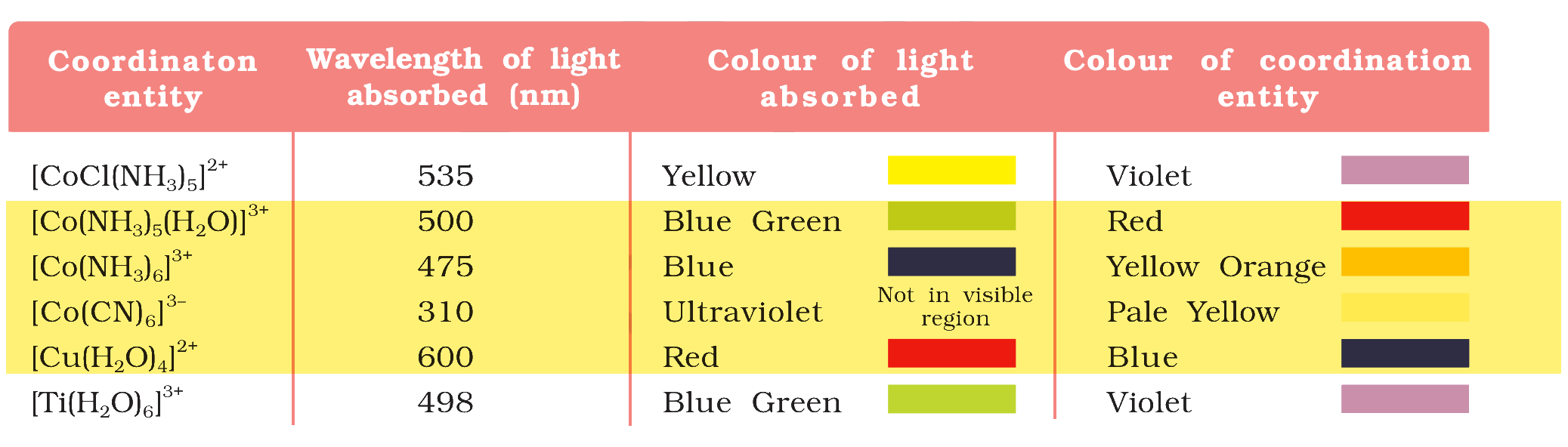
(A) \( \ce{[Co(NH3)6]^3+} \) — This matches (IV) Yellow orange. It absorbs blue light (475 nm), so it appears yellow orange.
(B) \( \ce{[Co(CN)6]^3-} \) — This matches (III) Pale yellow. It absorbs at 310 nm, in the ultraviolet, outside the visible region, so it is only pale yellow.
(C) \( \ce{[Cu(H2O)4]^2+} \) — This matches (II) Blue. It absorbs red light (600 nm), so it appears blue.
(D) \( \ce{[Co(NH3)5(H2O)]^3+} \) — This matches (I) Red. It absorbs blue green light (500 nm), so it appears red.
NCERT (2026-27 edition):
5.5.5 Colour in Coordination Compounds – “…The colour of the complex is complementary to that which is absorbed. The complementary colour is the colour generated from the wavelength left over; if green light is absorbed by the complex, it appears red. Table 5.3 gives the relationship of the different wavelength absorbed and the colour observed.”
Table 5.3: Relationship between the Wavelength of Light absorbed and the Colour observed in some Coordination Entities