Read the passage carefully and answer the questions based on the passage:
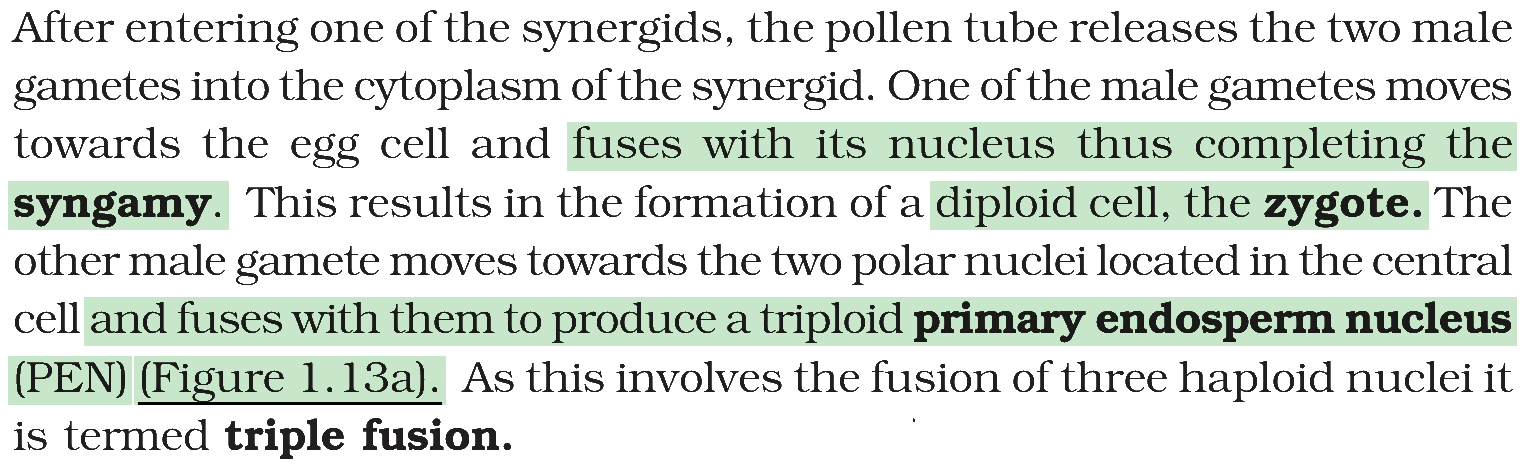
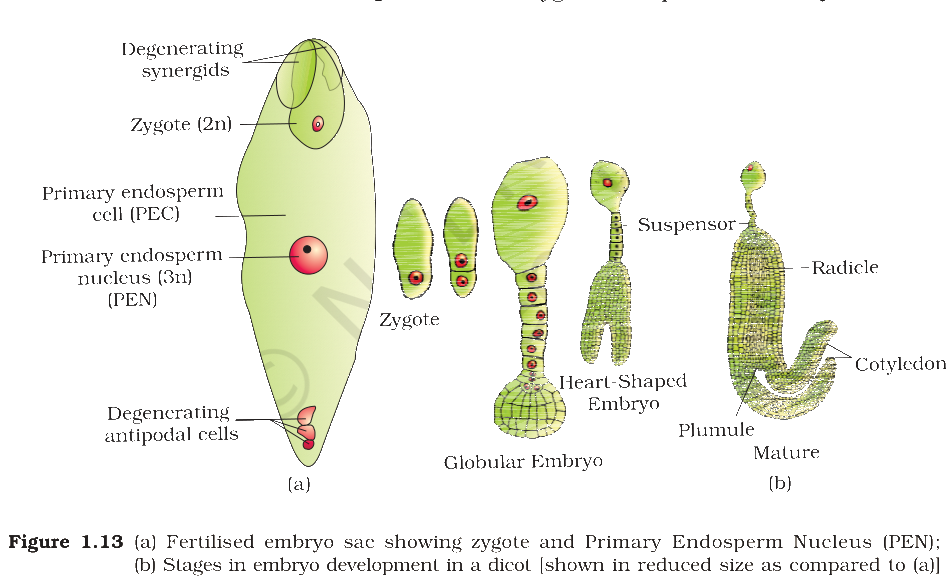
Pollen pistil interaction involves all events from the landing of pollen grains on the stigma until the pollen tube enters the embryo sac (when the pollen is compatible). When a pollen tube grows through the style and enters into the ovules, it finally discharges two male gametes in one of the synergids. Syngamy and triple fusion are two fusion events occur in angiosperms. Thus, angiosperms exhibit double fertilization. The products of these fusions are the diploid zygote and triploid primary endosperm nucleus. Zygote develops into embryo and primary endosperm cell forms the endosperm tissue. The developing embryo passes through different stages before maturation.
Formation of diploid zygote is a result of:
Answer & explanation
Correct answer: option 3
The correct answer is Option (3) → Syngamy
The passage names the two fusion events in angiosperms: syngamy and triple fusion. Their products are the diploid zygote and the triploid primary endosperm nucleus. The diploid zygote comes from syngamy, the fusion of one haploid male gamete (n) with the haploid egg (n): n + n = 2n.
Option (1) Emasculation — Incorrect. Emasculation is removing the anthers from a flower before they shed pollen, a step in artificial hybridisation.
Option (2) Triple fusion — Incorrect. Triple fusion joins three haploid nuclei and forms the triploid PEN, not the zygote.
Option (3) Syngamy — Correct. Syngamy is the fusion of a male gamete with the egg cell. Both are haploid, so their fusion forms the diploid zygote.
Option (4) Bagging — Incorrect. Bagging is covering an emasculated flower with a bag so that unwanted pollen cannot reach it.
Note: The passage is taken from NCERT. NTA has put lines of the NCERT text together to make it. Most CUET (UG) questions come straight from NCERT, so study the book line by line, including figures and their titles.
NCERT Extract:
Double Fertilisation –