CUETMOCK
  • Pricing
  • Mentors
Log inStart freeStart free mocks→

First test, then trust

Try a free CUET mock test.

Join 5,00,000+ students who rehearsed exam day on the exact NTA screen before sitting CUET. On the web and on Android.

Start free mocks →Get the Android app
CUETMOCK

India's #1 CUET Mock Test Platform. Original NCERT-based questions on the exact NTA exam screen — trusted by 5,00,000+ students since CUET 2022.

Get it onGoogle PlayScan to download the CUETMOCK app

Mock tests

  • CUET mock test series
  • Browse all papers
  • Commerce mocks
  • Humanities (Arts) mocks
  • Science mocks
  • Languages & GAT mocks
  • Free practice questions
  • Pricing

Resources

  • CUET exam guide
  • CUET syllabus
  • Universities accepting CUET
  • Expert blogs
  • News & notifications
  • Webinars & counselling
  • CUET score calculator
  • How we estimate your rank
  • FAQs

Company

  • About us
  • Our leadership & team
  • Our toppers
  • Mentors
  • For schools
  • Contact us
  • Terms
  • Privacy
  • Refund policy

Talk to us

+91 7696 6630 56info@cuetmock.comWhatsApp us

Our other platforms

  • JEE Mock — For IIT-JEE aspirants
  • NEET Mock — For NEET aspirants

Newsletter

Exam updates, study material and offers — no spam.

© 2026 NYC Ventures Pvt. Ltd.

701-702, Royal Business Park, Zirakpur, Punjab - 140603

  • Terms of use
  • Privacy policy
  • Refund policy
  • Contact us

iCUETMOCK is an independent preparation platform, not affiliated with the National Testing Agency (NTA). Always check exam details on the official NTA website.

  • Home
  • Mock tests
  • CUET guide
  • Pricing
  • Log in
Home/Practice questions/General Aptitude Test
General Aptitude TestVerbal ReasoningSyllogism

Read the given statements and conclusions carefully. Assuming that th…

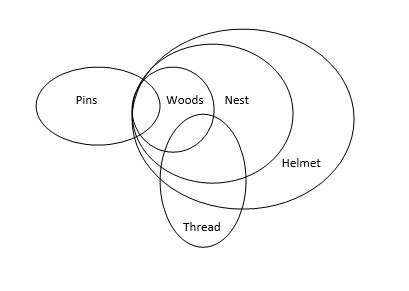
Read the given statements and conclusions carefully. Assuming that the information given in the statements is true, even if it appears to be at variance with commonly known facts, decide which of the given conclusions logically follow(s) from the statements.

Statement :

Some pins are wood

Some thread are wood

All wood are nest

All nest are helmet

Conclusion:

I.  Some pins are helmet

II.  Some thread are nest

III.  Some pins are thread

IV.  No pins are thread

Answer & explanation+

Correct answer: option 3


Con - I  √

       II  √

      III  ⇒

      IV  ⇒  either III or IV follows

Advertisement

Practise more on Verbal Reasoning

Chapter-wise mocks on the real NTA exam screen, with solutions and your rank. Your first mocks are free.

Start free mocks →

Advertisement

Next questions

  1. Which one of the following minerals is mainly used in the electrical and electronic industries?Geography · India-People and Economy: Mineral and Energy resources
  2. Identify the country having a dual party system.Political Science · Politics in India Since Independence: Era of one Party Dominance
  3. People who are used to an environment containing many persons around them develop more ____________ tolerance than people who are used to o…Psychology · Psychology and Life
  4. Select the option that is related to the fifth letter-cluster in the same way as the second letter-cluster is related to the first letter-c…General Aptitude Test · General Ability
  5. Select the most appropriate one-word substitution for the given group of words. Living on eating grass and vegetarian onlyEnglish · One Word
  6. What is the Pradhan Mantri Mudra Yojana?General Aptitude Test · General Knowledge
  7. Fe shows extra stability as Fe^3+ due toChemistry · Inorganic: D and F Block Elements
  8. Choose the correct Exclamatory form of the following sentence from the options given below: The students are excited to go for the excursio…English · Kinds of Sentence
  9. In which of the following countries was the headquarters of International Olympic Committee located as of February 2021?General Aptitude Test · General Knowledge
  10. Select the correct indirect form of the given sentence.The museum guard said to the boys, “Leave your bags in this locker.”English · Direct/indirect