
Read the following passage and answer the questions.
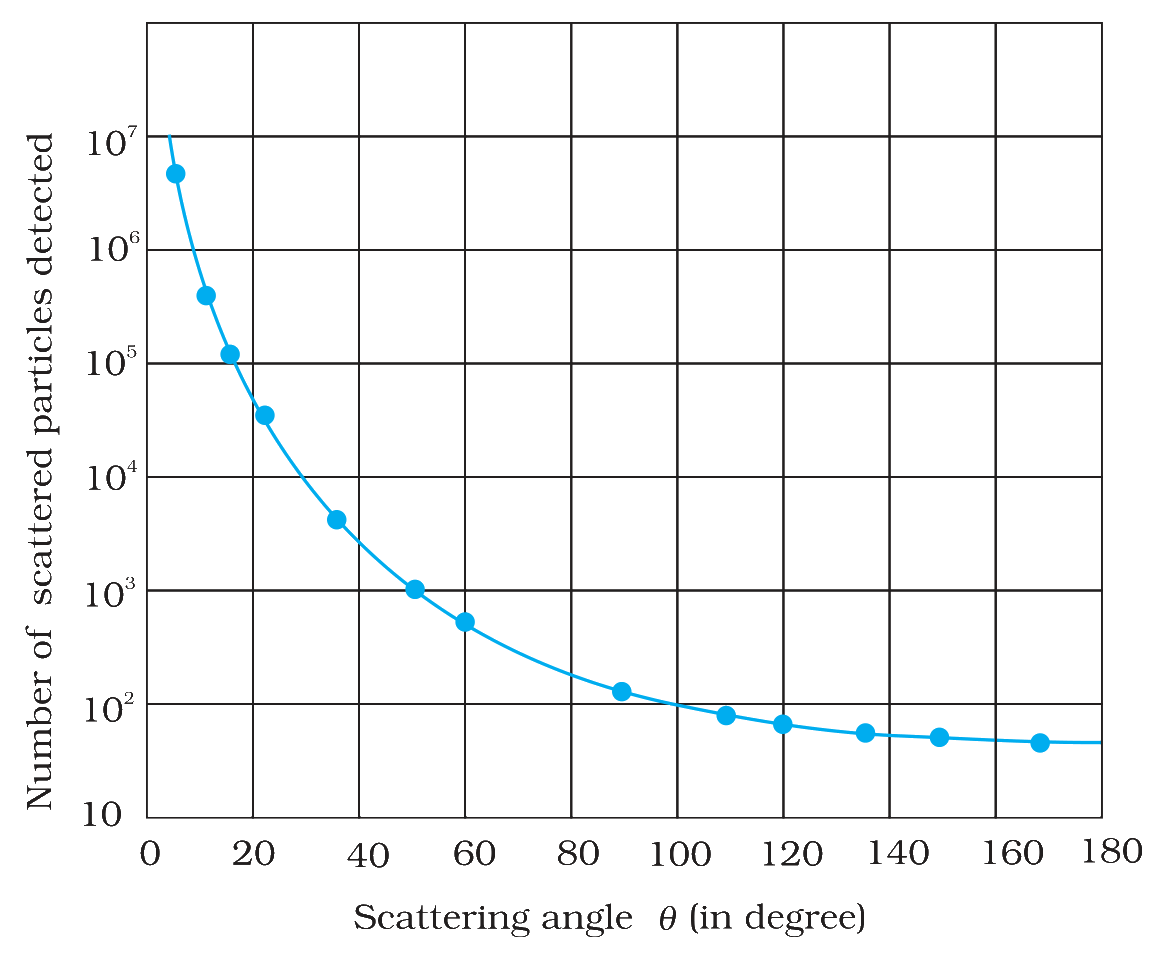
In 1911, H. Geiger and E. Marsden did a scattering experiment suggested by Rutherford. A radioactive source of \({}^{214}_{83}\mathrm{Bi}\) gave out alpha-particles of energy 5.5 MeV. The alpha-particles passed through lead bricks and then fell on a gold foil. The foil was only \(2.1\times10^{-7}\ \mathrm{m}\) thick. A detector made of a zinc sulphide screen and a microscope was placed near the foil. The detector could be turned around the foil. The whole apparatus was kept in a vacuum chamber. An alpha-particle carries a positive charge \(2e\). A gold nucleus carries a positive charge \(Ze\), with \(Z = 79\) for gold. The graph below shows the number of scattered alpha-particles detected at different scattering angles.
Consider the following statements about the path of an alpha-particle near a gold nucleus:
(A) An alpha-particle with a smaller impact parameter is scattered through a larger angle.
(B) In a head-on collision, the impact parameter is minimum and the alpha-particle rebounds back.
(C) The impact parameter is the distance of the alpha-particle from the centre of the nucleus at its point of closest approach.
(D) At the distance of closest approach, the alpha-particle touches the gold nucleus.
Choose the correct answer from the options given below:
Answer & explanation
Correct answer: option 3
The correct answer is Option (3) → (A) and (B) only
The path of an alpha-particle depends on its impact parameter \( b \). The closer it passes to the nucleus, the stronger the repulsion it feels.
(A) An alpha-particle with a smaller impact parameter is scattered through a larger angle. — True. A small \( b \) brings the alpha-particle close to the nucleus, where the repulsive force is large. So it is turned through a large angle.
(B) In a head-on collision, the impact parameter is minimum and the alpha-particle rebounds back. — True. In a head-on collision the alpha-particle moves straight at the nucleus. It stops for a moment and comes back, so \( \theta \approx \pi \).
(C) The impact parameter is the distance of the alpha-particle from the centre of the nucleus at its point of closest approach. — False. The impact parameter is the perpendicular distance of the initial velocity vector of the alpha-particle from the centre of the nucleus. It is fixed before the alpha-particle comes near the nucleus.
(D) At the distance of closest approach, the alpha-particle touches the gold nucleus. — False. The distance of closest approach is much larger than the sum of the radii of the gold nucleus and the alpha-particle. The alpha-particle turns back before it reaches the nucleus.
NCERT (2026-27):
Alpha-particle trajectory – “… It is seen that an α-particle close to the nucleus (small impact parameter) suffers large scattering. In case of head-on collision, the impact parameter is minimum and the α-particle rebounds back (θ ≅ π). …”
Alpha-particle trajectory – “The trajectory traced by an α-particle depends on the impact parameter, b of collision. The impact parameter is the perpendicular distance of the initial velocity vector of the α-particle from the centre of the nucleus …”
Example 12.2 – “… Thus, the α-particle reverses its motion without ever actually touching the gold nucleus.”