
CUETMOCK
  • Pricing
  • Mentors
Log inStart freeStart free mocks→

First test, then trust

Try a free CUET mock test.

Join 5,00,000+ students who rehearsed exam day on the exact NTA screen before sitting CUET. On the web and on Android.

Start free mocks →Get the Android app
CUETMOCK

India's #1 CUET Mock Test Platform. Original NCERT-based questions on the exact NTA exam screen — trusted by 5,00,000+ students since CUET 2022.

Get it onGoogle PlayScan to download the CUETMOCK app

Mock tests

  • CUET mock test series
  • Browse all papers
  • Commerce mocks
  • Humanities (Arts) mocks
  • Science mocks
  • Languages & GAT mocks
  • Free practice questions
  • Pricing

Resources

  • CUET exam guide
  • CUET syllabus
  • Universities accepting CUET
  • Expert blogs
  • News & notifications
  • Webinars & counselling
  • CUET score calculator
  • How we estimate your rank
  • FAQs

Company

  • About us
  • Our leadership & team
  • Our toppers
  • Mentors
  • For schools
  • Contact us
  • Terms
  • Privacy
  • Refund policy

Talk to us

+91 7696 6630 56info@cuetmock.comWhatsApp us

Our other platforms

  • JEE Mock — For IIT-JEE aspirants
  • NEET Mock — For NEET aspirants

Newsletter

Exam updates, study material and offers — no spam.

© 2026 NYC Ventures Pvt. Ltd.

701-702, Royal Business Park, Zirakpur, Punjab - 140603

  • Terms of use
  • Privacy policy
  • Refund policy
  • Contact us

iCUETMOCK is an independent preparation platform, not affiliated with the National Testing Agency (NTA). Always check exam details on the official NTA website.

  • Home
  • Mock tests
  • CUET guide
  • Pricing
  • Log in
Home/Practice questions/Fine Arts
Fine ArtsThe Rajasthani Schools of Painting

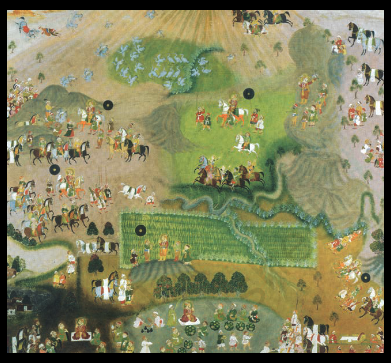
In what year was the hawking scene captured in the artwork?1) 16442)…

In what year was the hawking scene captured in the artwork?
1) 1644
2) 1744
3) 1844
4) 1944

Answer & explanation+

Correct answer: option 2

The correct answer is Option 2- 2 (1744)

The hawking scene featuring Maharana Jagat Singh II was captured in the year 1744.

In 1744, Maharana Jagat Singh II of Mewar engaged in hawking, capturing this moment, now preserved at the Metropolitan Museum of Art in New York.

Advertisement

Practise more on The Rajasthani Schools of Painting

Chapter-wise mocks on the real NTA exam screen, with solutions and your rank. Your first mocks are free.

Start free mocks →

Advertisement

Next questions

  1. Which of the following words means the same as 'diverge'English · Comprehension - (Narrative / Factual)
  2. Which of the following statement (s) is/are correct? Statement 1: Outsourcing has intensified due to advancements in information technology…Economics · Indian Economic Development: Liberalisation, Privatisation and Globalisation - An Appraisal
  3. According to Max Weber, "the place of classes is within the economic order, the place of status groups is within the social order". Where i…Sociology · Social Change and Development in India: The Constitution and Social Change
  4. ‘सन-सन करती शीत हवाएँ’ में कौन-सा अलंकार है?Hindi · अपठित काव्यांश (Comprehension - Poetry)
  5. Given below are two statements: one is labelled as Assertion (A) and the other is labelled as Reason (R). Assertion (A): The application an…Business Studies · Nature and significance of Management
  6. Who among the following was the founder of the Bolshevik Communist Party?Political Science · Contemporary World Politics: End of Bi-Polarity
  7. Who amongst the following are described as 'materialists'?History · Ancient India: Thinkers, Beliefs and Buildings
  8. In a code language, 'SOGGY' is written as ‘78’ and ‘PLINTH’is written as ‘85°. How will 'DEVOTION' be written in that language ?General Aptitude Test · Verbal Reasoning
  9. The bar magnet is brought close to the coil and then stopped. What happens after it is stopped?Physics · Electromagnetic Induction
  10. A member of a family who works without receiving wages in cash or in kind in a farm, business or trade run by the family is called a:Economics · Indian Economic Development: Employment - Growth, Informalisation and Other Issues