Match the LIST-I with LIST-II
| LIST-I | LIST-II | ||
| A. | The accumulated profits and reserves are transferred to | I. | No journal entry |
| B. | In case of dissolution partner's capital accounts are closed through | II. | Bank Account |
| C. | Unrecorded assets are transferred to | III. | Partners' Capital Accounts |
| D. | For settlement of the creditor's through transfer of assets in full and final settlement of his account | IV. | Realisation Account |
Choose the correct answer from the options given below:
Answer & explanation
Correct answer: option 4
The correct answer is Option (4) → A-III, B-II, C-IV, D-I
Each item is an entry made, or not made, when a firm is dissolved and its books are closed.
(A) The accumulated profits and reserves are transferred to — this matches (III) Partners’ Capital Accounts. Reserves are profits kept back from earlier years; they belong to the partners and are shared in the profit sharing ratio without passing through the Realisation Account.
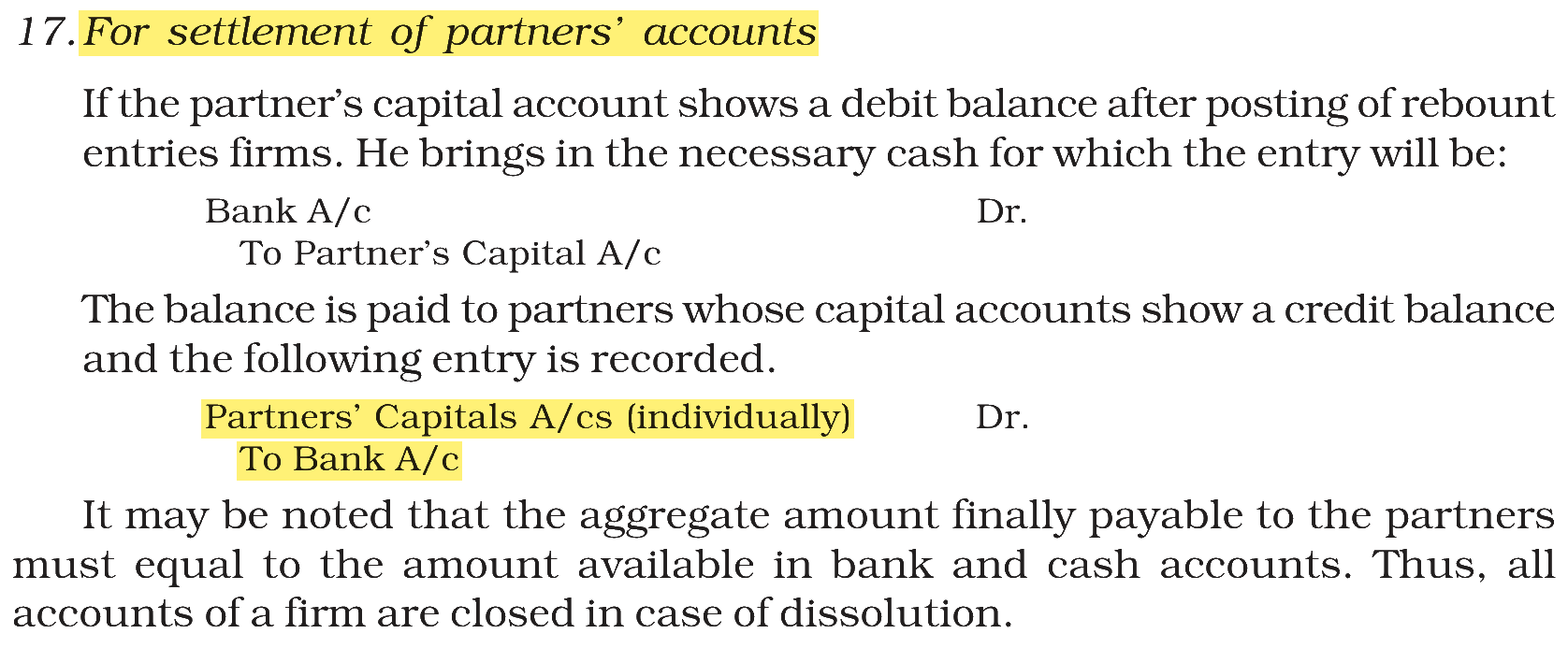
(B) In case of dissolution partner’s capital accounts are closed through — this matches (II) Bank Account. After every adjustment, the balance due to each partner is paid out of the bank, which closes his capital account.
(C) Unrecorded assets are transferred to — this matches (IV) Realisation Account. An asset that was never in the books comes into the Realisation Account when it is sold or taken over.
(D) For settlement of the creditor’s through transfer of assets in full and final settlement of his account — this matches (I) No journal entry. The asset and the creditor are both already in the Realisation Account, and the creditor takes the asset against his whole claim, so no cash moves.
NCERT (2026-27 edition): NCERT (2026-27 edition):
|