
The variation of electric field intensity due to a thin long straight wire of uniform linear charge density '\( \lambda \)' with distance r from the wire is correctly represented by:
Answer & explanation
Correct answer: option 2
The correct answer is Option (2)
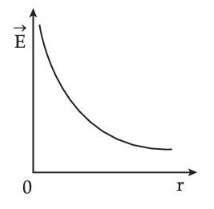
Gauss's law for a long straight wire uses a coaxial cylinder of radius \( r \) and length \( l \) as the Gaussian surface. The field is radial, so only the curved surface contributes.
\( \displaystyle E\,(2\pi r l) = \frac{\lambda l}{\varepsilon_0} \)
\( \displaystyle E = \frac{\lambda}{2\pi\varepsilon_0\,r} \;\Rightarrow\; E \propto \frac{1}{r} \)
So the field is inversely proportional to the distance: it is very large close to the wire and falls off steadily as \( r \) grows, never becoming zero. The \( E \)-\( r \) graph is a falling hyperbola, which is the graph in Option (2).
NCERT (2026-27):
Field Due to an Infinitely Long Straight Uniformly Charged Wire – “… In short, the electric field is everywhere radial in the plane cutting the wire normally, and its magnitude depends only on the radial distance r. … The surface includes charge equal to λl. Gauss’s law then gives E × 2πrl = λl/ε0
\( \displaystyle \text{i.e.,}\quad E = \frac{\lambda}{2\pi\varepsilon_0 r} \)”