
CUETMOCK
  • Pricing
  • Mentors
Log inStart freeStart free mocks→

First test, then trust

Try a free CUET mock test.

Join 5,00,000+ students who rehearsed exam day on the exact NTA screen before sitting CUET. On the web and on Android.

Start free mocks →Get the Android app
CUETMOCK

India's #1 CUET Mock Test Platform. Original NCERT-based questions on the exact NTA exam screen — trusted by 5,00,000+ students since CUET 2022.

Get it onGoogle PlayScan to download the CUETMOCK app

Mock tests

  • CUET mock test series
  • Commerce mocks
  • Humanities (Arts) mocks
  • Science mocks
  • Languages & GAT mocks
  • Free practice questions
  • Pricing

Resources

  • CUET exam guide
  • CUET syllabus
  • Universities accepting CUET
  • Expert blogs
  • News & notifications
  • Webinars & counselling
  • CUET score calculator
  • How we estimate your rank
  • FAQs

Company

  • About us
  • Our leadership & team
  • Our toppers
  • Mentors
  • For schools
  • Contact us
  • Terms
  • Privacy
  • Refund policy

Talk to us

+91 7696 6630 56info@cuetmock.comWhatsApp us

Our other platforms

  • JEE Mock — For IIT-JEE aspirants
  • NEET Mock — For NEET aspirants

Newsletter

Exam updates, study material and offers — no spam.

© 2026 NYC Ventures Pvt. Ltd.

701-702, Royal Business Park, Zirakpur, Punjab - 140603

  • Terms of use
  • Privacy policy
  • Refund policy
  • Contact us

iCUETMOCK is an independent preparation platform, not affiliated with the National Testing Agency (NTA). Always check exam details on the official NTA website.

  • Home
  • Mock tests
  • CUET guide
  • Pricing
  • Log in
Home/Practice questions/Biology
BiologyReproductive Health

Choose the incorrect statements about surgical methods of contracepti…

Choose the incorrect statements about surgical methods of contraception:

A. In vasectomy, a small part of the vas deferens is removed or tied up through a small incision on the scrotum.

B. In tubectomy, a small part of the uterus is removed or tied up through a small incision in the abdomen or through vagina.

C. Sterilisation procedure in the male is called vasectomy and that in the female, tubectomy.

D. Surgical methods are generally advised for couples who want to space children.

Choose the correct answer from the options given below:

Answer & explanation+

Correct answer: option 1

The correct answer is Option (1) → B and D only

Surgical methods, also called sterilisation, block the transport of gametes. They are advised as a terminal method for a partner who wants no more pregnancies, because their reversibility is very poor.

A. In vasectomy, a small part of the vas deferens is removed or tied up through a small incision on the scrotum. — True. This is the sterilisation procedure in the male.

B. In tubectomy, a small part of the uterus is removed or tied up through a small incision in the abdomen or through vagina. — False. In tubectomy, a small part of the fallopian tube is removed or tied up, not a part of the uterus.

C. Sterilisation procedure in the male is called vasectomy and that in the female, tubectomy. — True. This is how NCERT names the two procedures.

D. Surgical methods are generally advised for couples who want to space children. — False. Surgical methods are a terminal method to prevent any more pregnancies. For delaying pregnancy or spacing children, NCERT names IUDs as the ideal choice.

So the incorrect statements are B and D.

NCERT Extract:
Population Stabilisation and Birth Control – “Surgical methods, also called sterilisation, are generally advised for the male/female partner as a terminal method to prevent any more pregnancies. Surgical intervention blocks gamete transport and thereby prevent conception. Sterilisation procedure in the male is called ‘vasectomy’ and that in the female, ‘tubectomy’. In vasectomy, a small part of the vas deferens is removed or tied up through a small incision on the scrotum (Figure 3.4a) whereas in tubectomy, a small part of the fallopian tube is removed (Figure 3.4b) or tied up through a small incision in the abdomen or through vagina. These techniques are highly effective but their reversibility is very poor.”
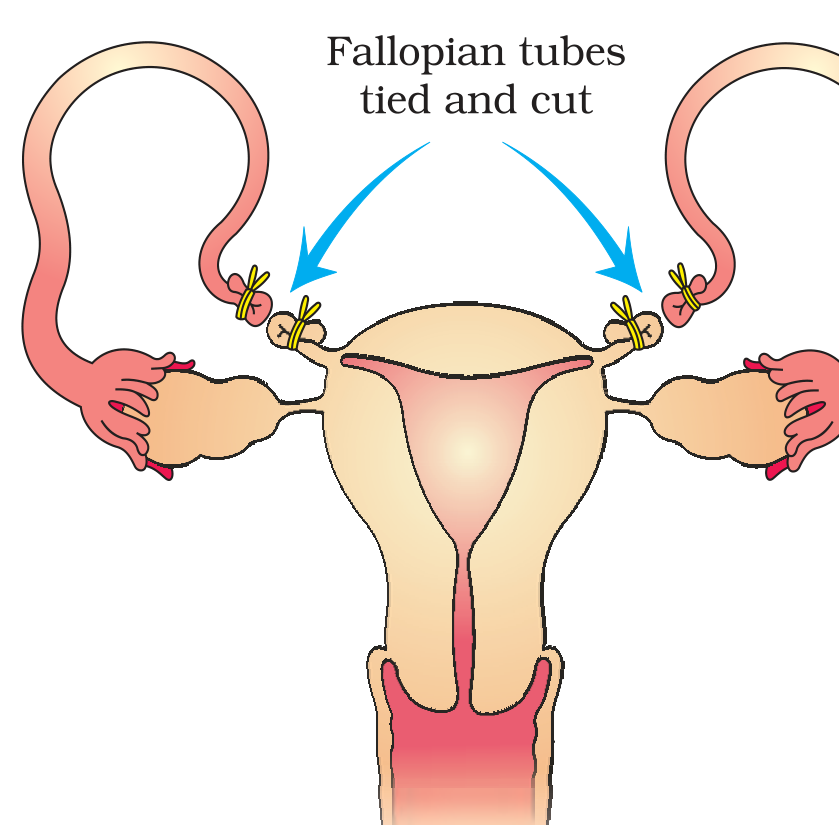
Textbook figure

Figure 3.4 (b) Tubectomy

Advertisement

Practise more on Reproductive Health

Chapter-wise mocks on the real NTA exam screen, with solutions and your rank. Your first mocks are free.

Start free mocks →

Advertisement

Next questions

  1. A sum of money becomes Rs 17820 after 4 years and Rs 23760 after 6 years at compound interest, compounded annually. What is half of the sum…General Aptitude Test · Numerical Ability
  2. In a sparged stirred-tank bioreactor, sterile air bubbles are sparged through the culture. Bubbling air through the reactor is an alternati…Biology · Biotechnology -Principles and Processes
  3. Choose the correct word to complete the following sentence:Right now, the bride, accompanied by her four sisters and a band of dhol players…English · Grammar: Subject-Verb Agreement
  4. A proton moves along a circle under the action of possible uniform electric and magnetic fields in a region. This region may have:Physics · Moving Charges and Magnetism
  5. Choose the correct option to change the following Interrogative sentence into an Assertive sentence:Shall I ever forget my first ride on th…English · Kinds of Sentence
  6. Poetic texts were favourite themes of the painters of the Rajasthani Schools. Which of the following pairs of a text and its author is corr…Fine Arts · The Rajasthani Schools of Painting
  7. Choose the most appropriate passive construction of the given sentence:The students of Class 11 elected Fatima class representative.English · Grammar: Active Passive Voice
  8. What is the mode of the following data? 11, 34, 22, 33, 12, 12, 4, 2, 12, 12General Aptitude Test · Numerical Ability
  9. The cultivators described in the passage were part of a collective village community in Mughal India. Which term was used for the village h…History · Medieval India: Peasants, Zamindars and the State
  10. Which force provides the centripetal force to the electron revolving around the nucleus in an atom?Physics · Atoms