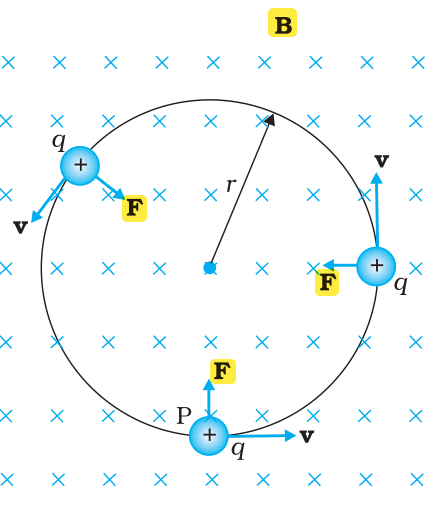
A proton moves along a circle under the action of possible uniform electric and magnetic fields in a region. This region may have:
Answer & explanation
Correct answer: option 2
The correct answer is Option (2) → E = 0, B ≠ 0
Circular motion needs a centripetal force of constant magnitude, always perpendicular to the velocity.
Option (1) E = 0, B = 0 — Incorrect. With no field there is no force, so the proton moves in a straight line.
Option (2) E = 0, B ≠ 0 — Correct. The magnetic force \( \vec{F} = e\left(\vec{v} \times \vec{B}\right) \) is always perpendicular to \( \vec{v} \), so the proton moves in a circle of radius \( r = mv/eB \).
Option (3) E ≠ 0, B = 0 — Incorrect. A uniform electric field exerts a constant force in a fixed direction, so the path is a straight line or a parabola.
Option (4) E ≠ 0, B ≠ 0 — Incorrect. The electric force changes the proton’s speed, so the path is a helix or a drifting curve, not a circle.
Note: NTA accepted both Option (2) and Option (4) in the Final Answer Key. The original question did not say that the fields are uniform, and with non-uniform fields a proton can also move in a circle when E ≠ 0 (for example, round a fixed negative charge), with or without a magnetic field. The word “uniform” has been added to the question for the benefit of students and to ensure a single answer.
Note: The same question was also asked in CUET (UG) 2023 on 14-06-2023 (Slot 1).
NCERT (2026-27):
Motion in a Magnetic Field – “… In the case of motion of a charge in a magnetic field, the magnetic force is perpendicular to the velocity of the particle. So no work is done and no change in the magnitude of the velocity is produced (though the direction of momentum may be changed).
We shall consider motion of a charged particle in a uniform magnetic field. … The perpendicular force, \( q\,\mathbf{v}\times\mathbf{B} \), acts as a centripetal force and produces a circular motion perpendicular to the magnetic field. The particle will describe a circle if \( \mathbf{v} \) and \( \mathbf{B} \) are perpendicular to each other (Fig. 4.5).”