
Read the paragraph given below and answer the question.
Sutton and Boveri argued that the pairing and separation of a pair of chromosomes would lead to the segregation of a pair of factors they carried. Sutton united the knowledge of chromosomal segregation with Mendelian principles and called it the chromosomal theory of inheritance.
Following this synthesis of ideas, experimental verification of the chromosomal theory of inheritance by Thomas Hunt Morgan and his colleagues, led to discovering the basis for the variation that sexual reproduction produced. Morgan worked with the tiny fruit flies, which were found very suitable for such studies. They could be grown on simple synthetic medium in the laboratory. They complete their life cycle in a short span of time and a single mating could produce a large number of progeny flies. Also, there was a clear differentiation of the sexes - the male and female flies are easily distinguishable. Also, it has many types of hereditary variations that can be seen with low power microscopes.
The scientist who noted that "The behaviour of chromosomes was parallel to the behaviour of gene" were:
Answer & explanation
Correct answer: option 1
The correct answer is Option (1) → Sutton and Boveri
Option (1) Sutton and Boveri — Correct. Of the options, only Sutton and Boveri made this observation. De Vries, Correns and von Tschermak had rediscovered Mendel’s results.
Note 1: The passage is taken from NCERT. NTA has put lines of the NCERT text together to make it. Most CUET (UG) questions come straight from NCERT, so study the book line by line, including figures and their titles.
Note 2: A similar question was also asked in CUET (UG) 2025 on 27-05-2025 (Slot 2).
NCERT Extract:
Chromosomal Theory of Inheritance – “… In 1900, three Scientists (de Vries, Correns and von Tschermak) independently rediscovered Mendel’s results on the inheritance of characters. Also, by this time due to advancements in microscopy that were taking place, scientists were able to carefully observe cell division. This led to the discovery of structures in the nucleus that appeared to double and divide just before each cell division. These were called chromosomes (colored bodies, as they were visualised by staining). By 1902, the chromosome movement during meiosis had been worked out. Walter Sutton and Theodore Boveri noted that the behaviour of chromosomes was parallel to the behaviour of genes and used chromosome movement (Figure 4.8) to explain Mendel’s laws (Table 4.3).”
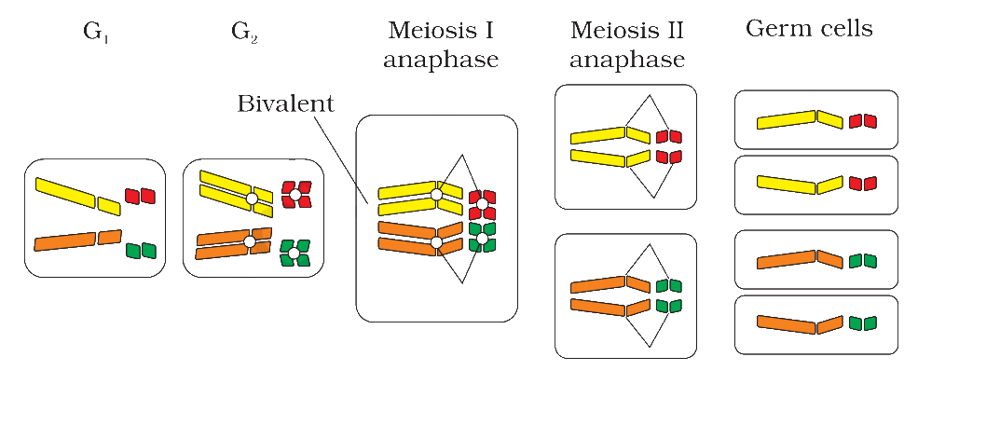
Figure 4.8 Meiosis and germ cell formation in a cell with four chromosomes.