Match List - I with List - II.
| List - I | List - II |
| (A) High powered money | (I) \( \displaystyle\frac{1}{\text{Cash Reserve Ratio}} \) |
| (B) Central Bank | (II) Fixed by the RBI |
| (C) Money multiplier | (III) An apex bank of the country |
| (D) Cash Reserve Ratio | (IV) Currency issued by central bank |
Choose the correct answer from the options given below :
Answer & explanation
Correct answer: option 4
The correct answer is Option (4) → (A)-(IV), (B)-(III), (C)-(I), (D)-(II)
All four terms belong to how money is created and controlled in a country. The central bank issues the currency and sets the rules, and commercial banks create deposits within those rules.
| List-I | List-II | Reason |
|---|---|---|
| (A) High powered money | (IV) Currency issued by central bank | It is the money put into the economy by the central bank, mainly the currency it issues. The Reserve Bank is the only institution that can issue currency. |
| (B) Central Bank | (III) An apex bank of the country | It is the top bank of the country. It is banker to the government and a bank to the banking system. |
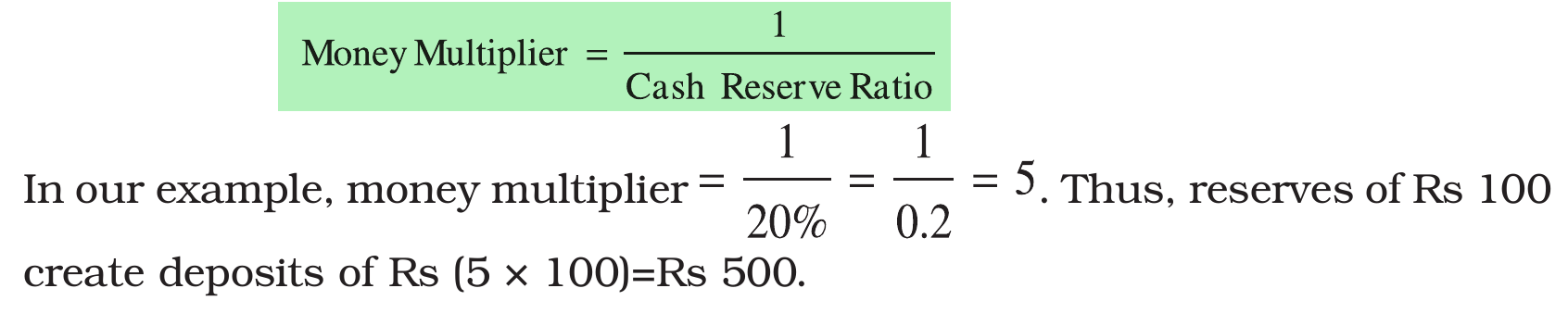
| (C) Money multiplier | (I) \( \displaystyle\frac{1}{\text{Cash Reserve Ratio}} \) | The money multiplier is 1 divided by the CRR. With a CRR of 20 per cent it is 1/0.2 = 5, so reserves of ₹ 100 support deposits of ₹ 500. |
| (D) Cash Reserve Ratio | (II) Fixed by the RBI | The RBI decides the percentage of deposits that every bank must keep as cash reserves. |
NCERT (2026-27): “Central bank Central Bank is a very important institution in a modern economy. Almost every country has one central bank. India got its central bank in 1935. Its name is the ‘Reserve Bank of India’. Central bank has several important functions. It issues the currency of the country. It controls money supply of the country through various methods, like bank rate, open market operations and variations in reserve ratios. It acts as a banker to the government. It is the custodian of the foreign exchange reserves of the economy. It also acts as a bank to the banking system, which is discussed in detail later. From the point of view of money supply, we need to focus on its function of issuing currency. This currency issued by the central bank can be held by the public or by the commercial banks, and is called the ‘high-powered money’ or ‘reserve money’ or ‘monetary base’ as it acts as a basis for credit creation. 3.3.2 Limits to Credit Creation and Money Multiplier … But is there a limit to money or credit creation by banks? Yes, and this is determined by the Central bank (RBI). The RBI decides a certain percentage of deposits which every bank must keep as reserves. This is done to ensure that no bank is ‘over lending’. This is a legal requirement and is binding on the banks. This is called the ‘Required Reserve Ratio’ or the ‘Reserve Ratio’ or ‘Cash Reserve Ratio’ (CRR).…”
|