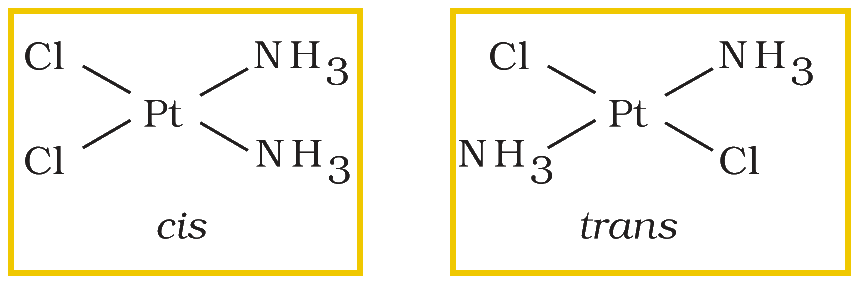
What are the two types of isomerism that exist in \([Pt(Cl)_2(NO_2)_2]^{2-}\) ?
Answer & explanation
Correct answer: option 1
The correct answer is Option (1) → Linkage and geometrical
Find the oxidation state of Pt first. Cl− and NO2− each carry a charge of −1:
x + 2(−1) + 2(−1) = −2, so x = +2
Pt(II) is a d8 ion and forms square planar complexes. The complex is of the type [MX2L2] with two kinds of unidentate ligands.
Geometrical isomerism: the two Cl ligands can be next to each other (cis) or opposite each other (trans) in the square.
Linkage isomerism: \( \ce{NO2^{-}} \) is an ambidentate ligand. It can bind through N (nitro, –NO2) or through O (nitrito, –ONO).
Why the other options are incorrect
Option (2) Hydration and geometrical — Incorrect. Hydration (solvate) isomerism needs water molecules that can be inside or outside the coordination sphere. This complex has no water.
Option (3) Hydration and optical — Incorrect. There is no water, and a square planar complex lies in a plane of symmetry, so it is not optically active.
Option (4) Linkage and optical — Incorrect. Linkage isomerism is possible, but a square planar complex does not show optical isomerism.
NCERT (2026-27 edition):
Linkage Isomerism – “Linkage isomerism arises in a coordination compound containing ambidentate ligand. A simple example is provided by complexes containing the thiocyanate ligand, NCS–, which may bind through the nitrogen to give M–NCS or through sulphur to give M–SCN. Jørgensen discovered such behaviour in the complex [Co(NH3)5(NO2)]Cl2, which is obtained as the red form, in which the nitrite ligand is bound through oxygen (–ONO), and as the yellow form, in which the nitrite ligand is bound through nitrogen (–NO2).”
Geometric Isomerism – “This type of isomerism arises in heteroleptic complexes due to different possible geometric arrangements of the ligands. Important examples of this behaviour are found with coordination numbers 4 and 6. In a square planar complex of formula [MX2L2] (X and L are unidentate), the two ligands X may be arranged adjacent to each other in a cis isomer, or opposite to each other in a trans isomer as depicted in Fig. 5.2.”