
Passage
Chemical Kinetics
Some reactions such as ionic reactions occur very fast, for example, precipitation of silver chloride occurs instantaneously by mixing of aqueous solutions of silver nitrate and sodium chloride. On the other hand, some reactions are very slow, for example, rusting of iron in the presence of air and moisture. The sum of powers of the concentration of the reactants in the rate law expression is called the order of that chemical reaction. Another property of a reaction called molecularity helps in understanding its mechanism. The number of reacting species (atoms, ions or molecules) taking part in an elementary reaction, which must collide simultaneously in order to bring about a chemical reaction is called molecularity of a reaction. The half-life (t1/2) of a reaction is the time in which the concentration of a reactant is reduced to one-half of its initial concentration.
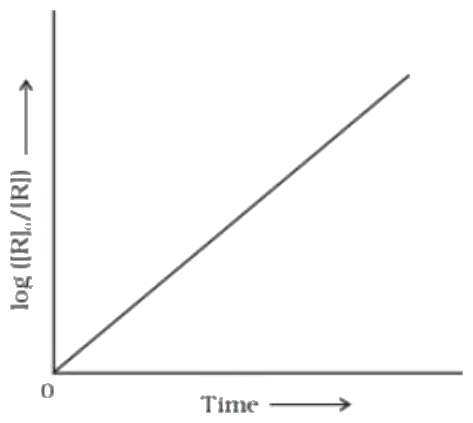
In the following graph for first order reaction the slope is
Answer & explanation
Correct answer: option 1
The correct answer is Option (1) → = k/2.303
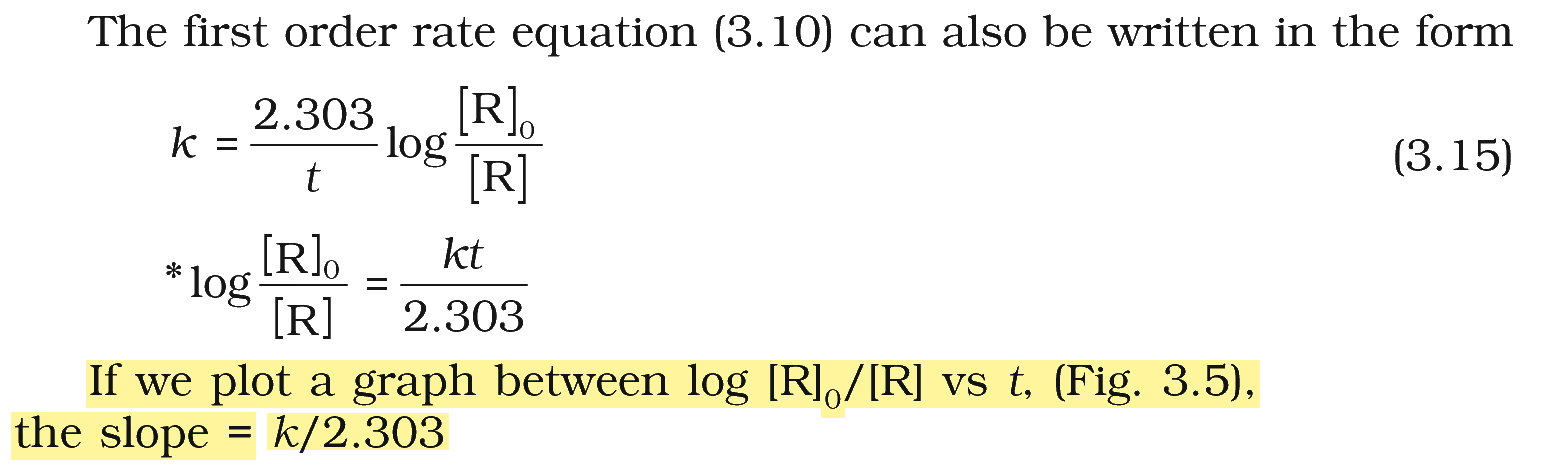
For a first order reaction, the integrated rate equation is:
\( \displaystyle k=\frac{2.303}{t}\log\frac{[R]_0}{[R]} \)
Rearranging it to show the dependence on time:
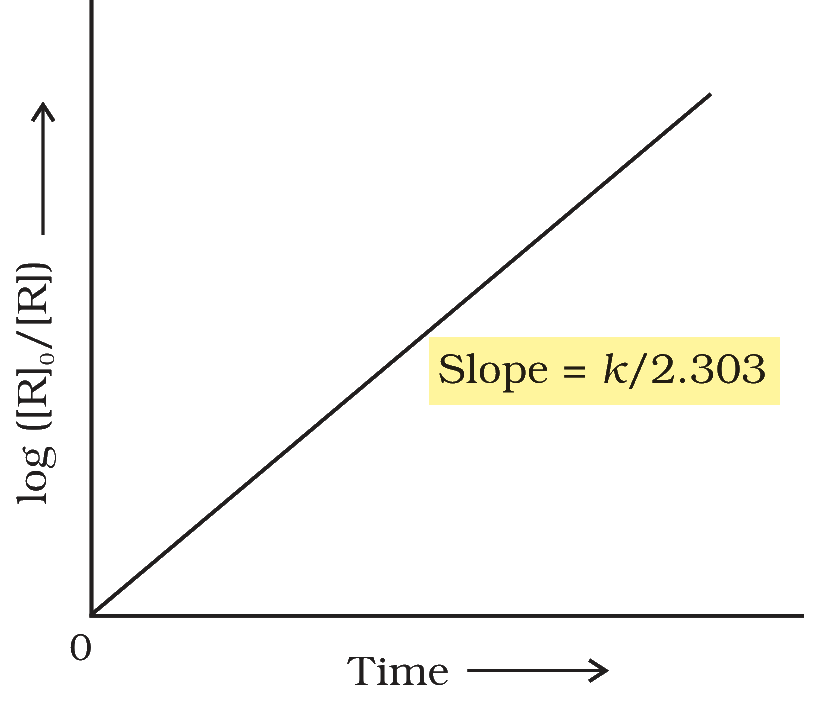
\( \displaystyle \log\frac{[R]_0}{[R]}=\frac{k}{2.303}\,t \)
This has the form y = mx, a straight line through the origin. With log([R]0/[R]) on the y-axis and time on the x-axis, the slope is k/2.303. The slope is positive, as the rising line in the figure shows.
Why the other options are incorrect
Option (2) = 2.303/k — Incorrect. This is the reciprocal of the slope; it has the unit of time, while the slope has the unit of k.
Option (3) = −k/2.303 — Incorrect. This is the slope of the plot of log [R] against time, since log [R] = −kt/2.303 + log [R]0. That line falls with time.
Option (4) = −2.303/k — Incorrect. This is the negative reciprocal of the slope. It has the unit of time, while the slope has the unit of k (s−1).
NCERT (2026-27 edition):
First Order Reactions – …
Note: The same/similar question has been asked in different years by NTA as per the details given below:
| 2026 | 2025 | 2024 | 2023 | 2022 |
|---|---|---|---|---|
| 26-05 S1 19-05 S1 | – | – | – | – |