
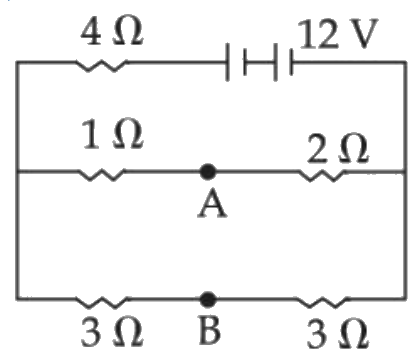
The above circuit potential difference between point A and B \( (V_A - V_B) = \)
Answer & explanation
Correct answer: option 2
The correct answer is Option (2) → \( \displaystyle\frac{2}{3}\,\mathrm{V} \)
The 12 V battery and the \( 4\,\Omega \) resistor are in series with two parallel branches: the middle branch (\( 1\,\Omega \) and \( 2\,\Omega \), total \( 3\,\Omega \)) and the lower branch (\( 3\,\Omega \) and \( 3\,\Omega \), total \( 6\,\Omega \)). The battery is taken as ideal.
\( \displaystyle R_{\mathrm{eq}} = 4 + \frac{3\times6}{3 + 6} = 4 + 2 = 6\,\Omega \)
\( \displaystyle I = \frac{12}{6} = 2\,\mathrm{A} \)
The current divides between the parallel branches in the inverse ratio of their resistances:
\( \displaystyle I_1 = 2\times\frac{6}{9} = \frac{4}{3}\,\mathrm{A} \quad (\text{middle branch}) \)
\( \displaystyle I_2 = 2\times\frac{3}{9} = \frac{2}{3}\,\mathrm{A} \quad (\text{lower branch}) \)
The positive terminal of the battery (longer plate) is on the left, so the current flows from the left junction L through the branches to the right. The potential falls along the current:
\( \displaystyle V_L - V_A = I_1\times1 = \frac{4}{3}\,\mathrm{V} \)
\( \displaystyle V_L - V_B = I_2\times3 = \frac{2}{3}\times3 = 2\,\mathrm{V} \)
Subtracting:
\( \displaystyle V_A - V_B = 2 - \frac{4}{3} = \frac{2}{3}\,\mathrm{V} \)