
CUETMOCK
  • Pricing
  • Mentors
Log inStart freeStart free mocks→

First test, then trust

Try a free CUET mock test.

Join 5,00,000+ students who rehearsed exam day on the exact NTA screen before sitting CUET. On the web and on Android.

Start free mocks →Get the Android app
CUETMOCK

India's #1 CUET Mock Test Platform. Original NCERT-based questions on the exact NTA exam screen — trusted by 5,00,000+ students since CUET 2022.

Get it onGoogle PlayScan to download the CUETMOCK app

Mock tests

  • CUET mock test series
  • Browse all papers
  • Commerce mocks
  • Humanities (Arts) mocks
  • Science mocks
  • Languages & GAT mocks
  • Free practice questions
  • Pricing

Resources

  • CUET exam guide
  • CUET syllabus
  • Universities accepting CUET
  • Expert blogs
  • News & notifications
  • Webinars & counselling
  • CUET score calculator
  • How we estimate your rank
  • FAQs

Company

  • About us
  • Our leadership & team
  • Our toppers
  • Mentors
  • For schools
  • Contact us
  • Terms
  • Privacy
  • Refund policy

Talk to us

+91 7696 6630 56info@cuetmock.comWhatsApp us

Our other platforms

  • JEE Mock — For IIT-JEE aspirants
  • NEET Mock — For NEET aspirants

Newsletter

Exam updates, study material and offers — no spam.

© 2026 NYC Ventures Pvt. Ltd.

701-702, Royal Business Park, Zirakpur, Punjab - 140603

  • Terms of use
  • Privacy policy
  • Refund policy
  • Contact us

iCUETMOCK is an independent preparation platform, not affiliated with the National Testing Agency (NTA). Always check exam details on the official NTA website.

  • Home
  • Mock tests
  • CUET guide
  • Pricing
  • Log in
Home/Practice questions/Physics
PhysicsRay Optics

The sun (diameter D) subtends an angle of θ radians at the pole of a…

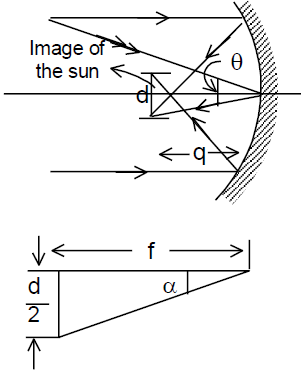
The sun (diameter D) subtends an angle of θ radians at the pole of a concave mirror of focal length f. The diameter of the image of the sun formed by the mirror is

Answer & explanation+

Correct answer: option 1

Since the sun is at very large distance, p = ∞

$⇒\frac{1}{∞}+\frac{1}{q}=\frac{1}{f}$

$⇒g=f$

If the diameter of the image be 

$\frac{d/2}{q}=α⇒d=(2α)q$

Putting $2α = θ$ and $q = f$

we obtain $D=fθ$
Advertisement

Practise more on Ray Optics

Chapter-wise mocks on the real NTA exam screen, with solutions and your rank. Your first mocks are free.

Start free mocks →

Advertisement

Next questions

  1. 'चमकीला' शब्द में कौन सा प्रत्यय होगा?Hindi · व्याकरण - सप्रत्यय
  2. Which term is used for a mode of thinking in which the desire to reach unanimous agreement overrides the wish to adopt proper, rational, de…Psychology · Social Influence and Group Processes
  3. A manager should replace "I" with "We" in all his conversation with workers to foster team spirit. Identify the principle of management sta…Business Studies · Principles of Management
  4. The line chart given below shows the sales of two companies A and B in 5 years. J1 = The total sales of A in all years. J2 = The total sale…General Aptitude Test · Quantitative Reasoning
  5. Calculate the Net Working Capital, from the following information of Mr. Sahib. (a) Short term loan - 1,00,000/- (b) Debtors - 65,000/- (c)…Entrepreneurship · Business Arithmetic
  6. What is parthenogenesis?Biology · Reproduction in Organisms
  7. ABC is an isosceles triangle with AC = BC. If ∠ A=65^° , then what is the measure of ∠ C ?General Aptitude Test · Quantitative Reasoning
  8. Three charges are arranged on the vertices of an equilateral triangle. Find the dipole moment of the combination.Physics · Electric Charges and Fields
  9. Which physical theory explains the generation of thrust by rocket engines, jet engines and deflating balloons?General Aptitude Test · General Knowledge
  10. Who is the present Secretary General of the United Nations?Political Science · Contemporary World Politics: International Organisations