The equation of demand curve of a good for a consumer is given to be \( pq = e \) where e is a constant. What will be the shape of the demand curve?
Answer & explanation
Correct answer: option 3
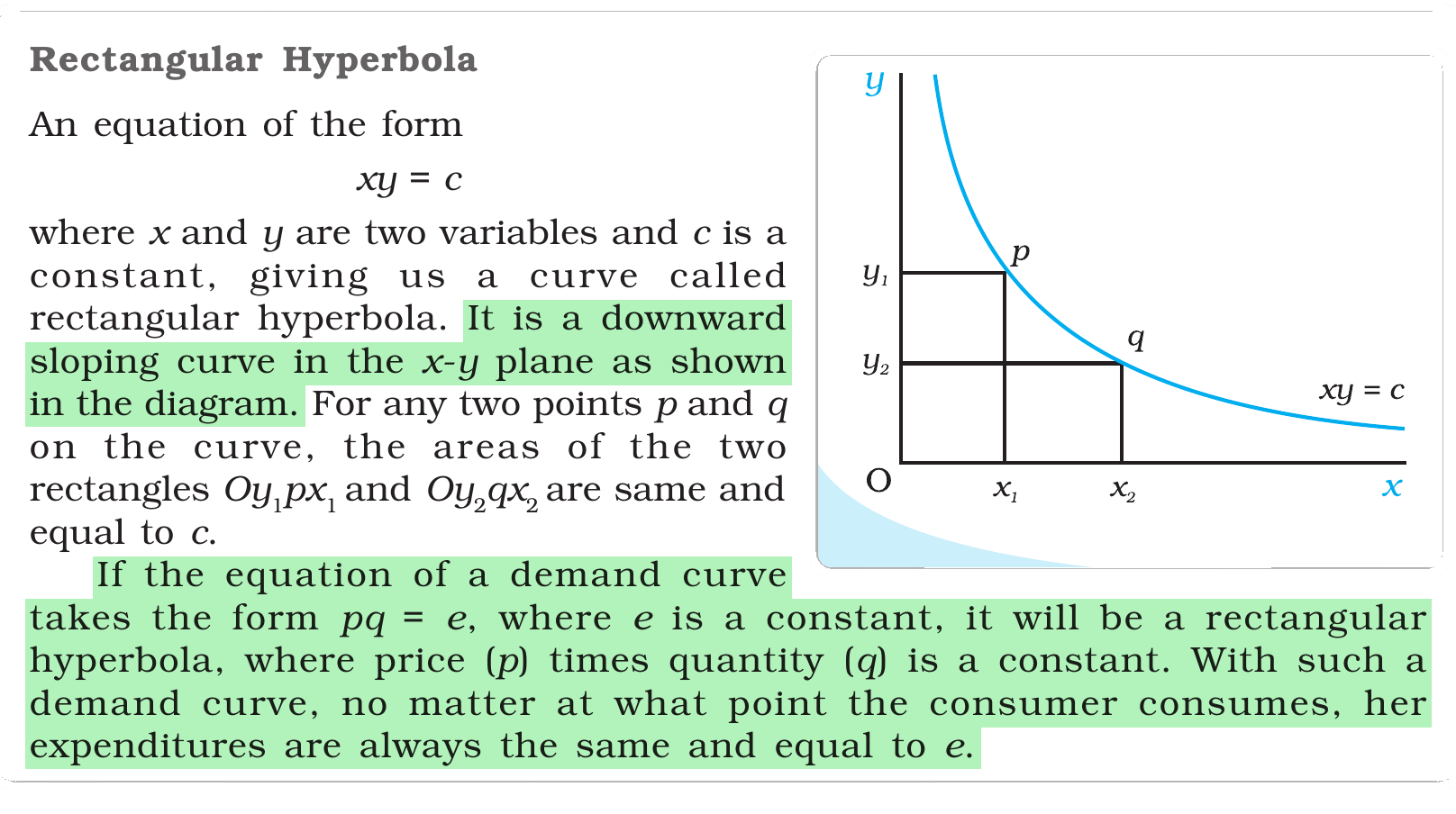
The correct answer is Option (3) → Downward sloping rectangular hyperbola.
An equation of the form xy = c, with c a constant, gives a rectangular hyperbola. Here pq = e, so price times quantity stays the same at every point. If q rises, p must fall, so the curve slopes downward.
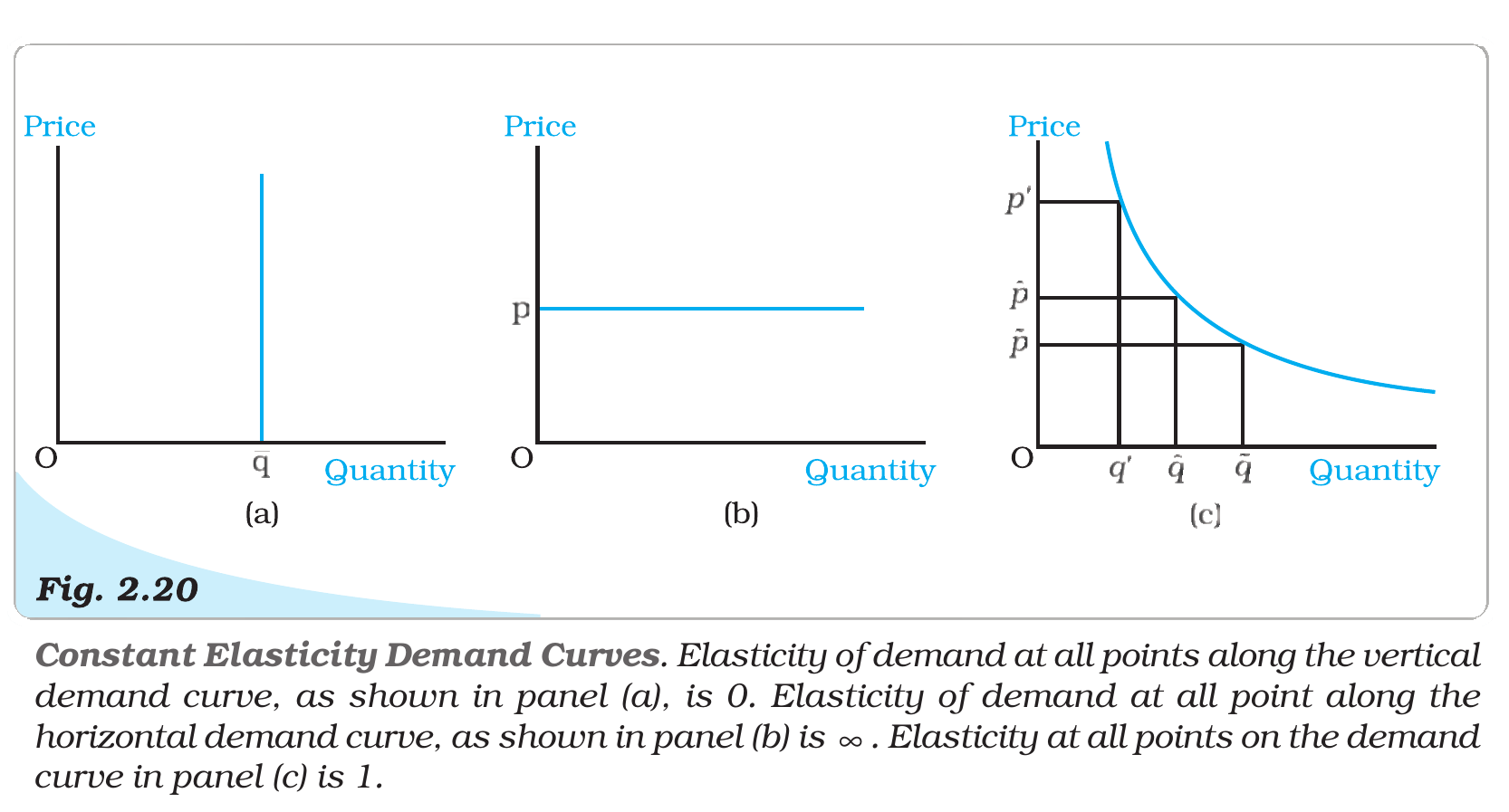
Option (1) Parallel to x axis. — Incorrect. A horizontal demand curve has the same price at every quantity. This is perfectly elastic demand. In pq = e, the price changes when quantity changes.
Option (2) Parallel to y axis. — Incorrect. A vertical demand curve has the same quantity at every price. This is perfectly inelastic demand. In pq = e, the quantity changes when price changes.
Option (3) Downward sloping rectangular hyperbola. — Correct. Spending, pq, is the same at every point. So a percentage change in price leads to an equal percentage change in quantity, and elasticity is 1 at every point.
Option (4) Downward sloping straight line forming an angle of 135° with x axis. — Incorrect. A straight-line demand curve has the form q = a − bp. Along it, pq does not stay constant.
NCERT (2026-27): “Constant Elasticity Demand Curve … Consider, for example, a vertical demand curve as the one depicted in Figure 2.20(a). Whatever be the price, the demand is given at the level q̄. A price never leads to a change in the demand for such a demand curve and |eD| is always 0. Therefore, a vertical demand curve is perfectly inelastic. Figure 2.20 (b) depics a horizontal demand curve, where market price remains constant at P̄, whatever be the level of demand for the commodity. At any other price, quantity demanded drops to zero and therefore ed = ∞. A horizontal demand curve is perfectly elastic.… Figure 2.20(c) depicts a demand curve which has the shape of a rectangular hyperbola. This demand curve has a property that a percentage change in price along the demand curve always leads to equal percentage change in quantity. Therefore, |eD| = 1 at every point on this demand curve. This demand curve is called the unitary elastic demand curve.”
|