
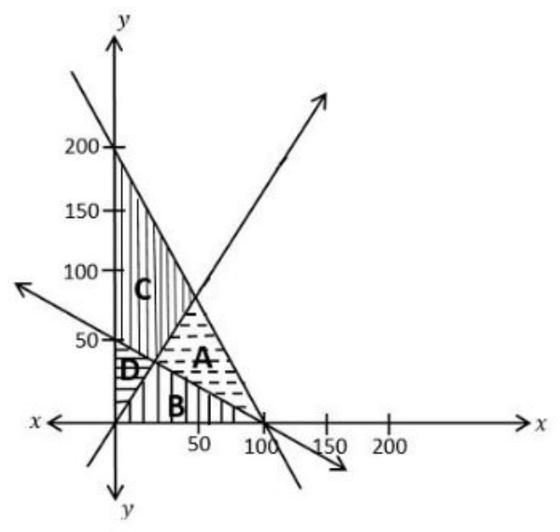
The feasible region represented by the constraints: \(x + 2y \ge 100,\ 2x - y \le 0,\ 2x + y \le 200,\ x \ge 0,\ y \ge 0\) of an LPP is:
Answer & explanation
Correct answer: option 3
The correct answer is Option (3) → Region C
Each constraint is a half-plane; the side of each boundary line is found with the origin test.
\(x + 2y \ge 100\): origin gives \(0 \ge 100\), false, so the side away from the origin.
\(2x - y \le 0\), that is \(y \ge 2x\): the side above the line \(y = 2x\), towards the y-axis.
\(2x + y \le 200\): origin gives \(0 \le 200\), true, so the side containing the origin.
\(x \ge 0,\ y \ge 0\): the first quadrant.
The corner points of the common region are where these lines meet:
\(x = 0\) with \(x + 2y = 100\): (0, 50)
\(y = 2x\) with \(x + 2y = 100\): (20, 40)
\(y = 2x\) with \(2x + y = 200\): (50, 100)
\(x = 0\) with \(2x + y = 200\): (0, 200)
So the feasible region lies between the y-axis and the line \(y = 2x\), above \(x + 2y = 100\) and below \(2x + y = 200\). For example, (10, 100) satisfies every constraint:
\(10 + 200 = 210 \ge 100,\quad 20 - 100 = -80 \le 0,\quad 20 + 100 = 120 \le 200\)
This is Region C.