Read the passage carefully and answer the Questions.
Aldehydes and ketones are important organic compounds prepared mainly by oxidation of alcohols. Primary alcohols give aldehyde and secondary alcohols yield ketones. Aldehydes can also be formed by partial reduction of acid chlorides, reduction of esters or by Gattermann-Koch reaction. Ketones are prepared via Friedel-Craft's acylation, hydration of alkyne and reaction of Grignard's reagent with nitriles. Chemically, aldehydes and ketones are reactive in nature due to the carbonyl group and undergo nucleophilic addition reactions. Aldehydes are more reactive than ketones and can be oxidized to carboxylic acids, while both can be reduced to alcohols or hydrocarbons and exhibit condensation reaction.
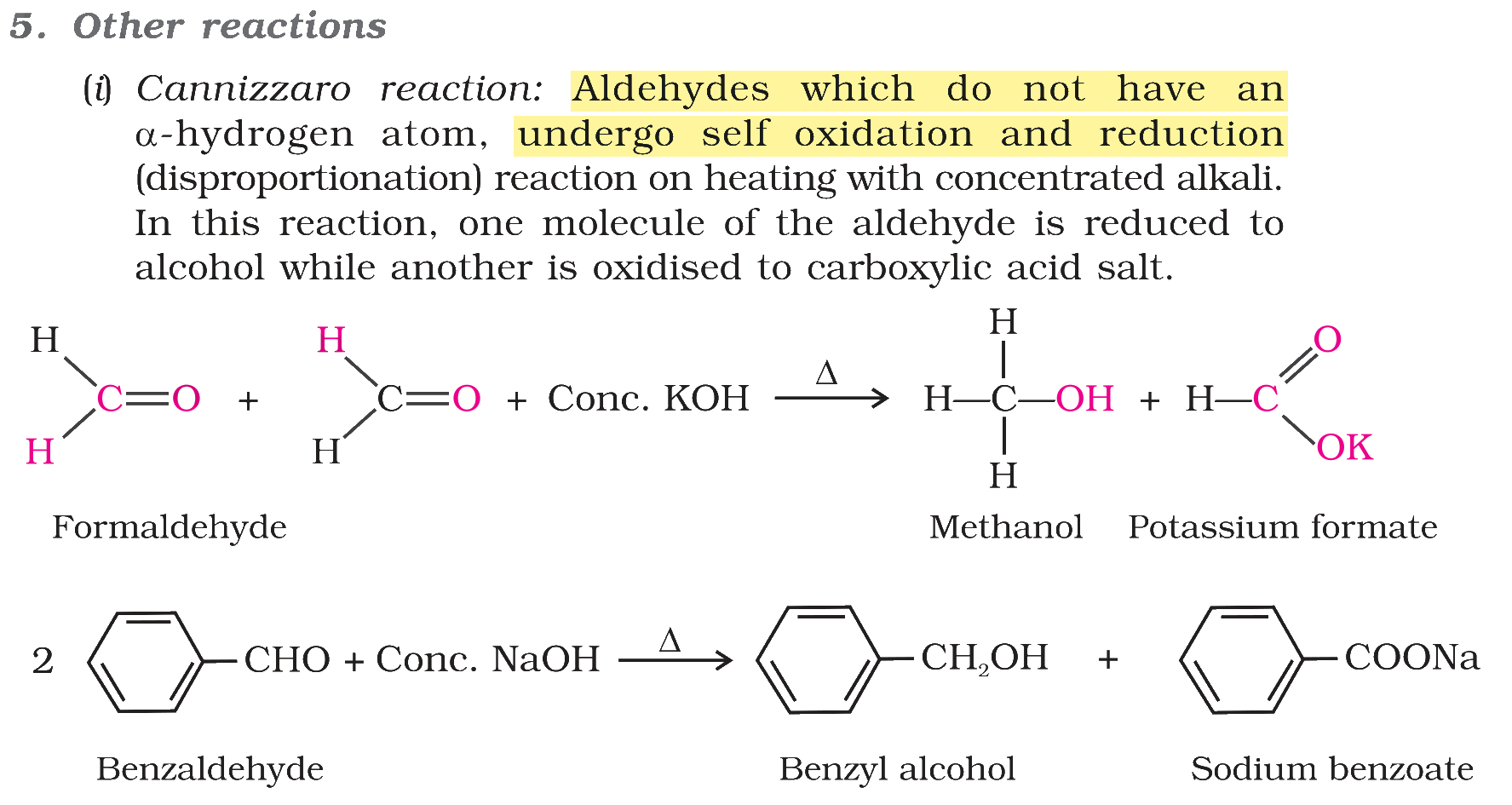
When two moles of benzaldehyde are heated with concentrated NaOH solution, the product/s obtained is/are;
Answer & explanation
Correct answer: option 1
The correct answer is Option (1) → Benzyl alcohol and sodium benzoate.
Benzaldehyde has no α-hydrogen atom, so with concentrated alkali it undergoes the Cannizzaro reaction.
The hydroxide ion adds to the carbonyl carbon of one benzaldehyde molecule, and this adduct transfers a hydride ion to the carbonyl carbon of a second molecule. The first molecule ends up as benzoate, the second as benzyl alcohol.
So two moles of benzaldehyde give benzyl alcohol and sodium benzoate, one mole of each.
Why the other options are incorrect
Option (2) Benzyl alcohol only. — Incorrect. This is only the reduced half of the reaction; the electrons needed for the reduction come from the oxidation of the second molecule.
Option (3) Sodium benzoate only. — Incorrect. This is only the oxidised half; nothing else is present to take up the electrons, so the other molecule must be reduced.
Option (4) Benzophenone only. — Incorrect. Benzophenone, \( \ce{C6H5COC6H5} \), is a ketone with a new carbon–carbon bond between two phenyl groups; no such bond is formed in the Cannizzaro reaction.
NCERT (2026-27 edition):
Other Reactions