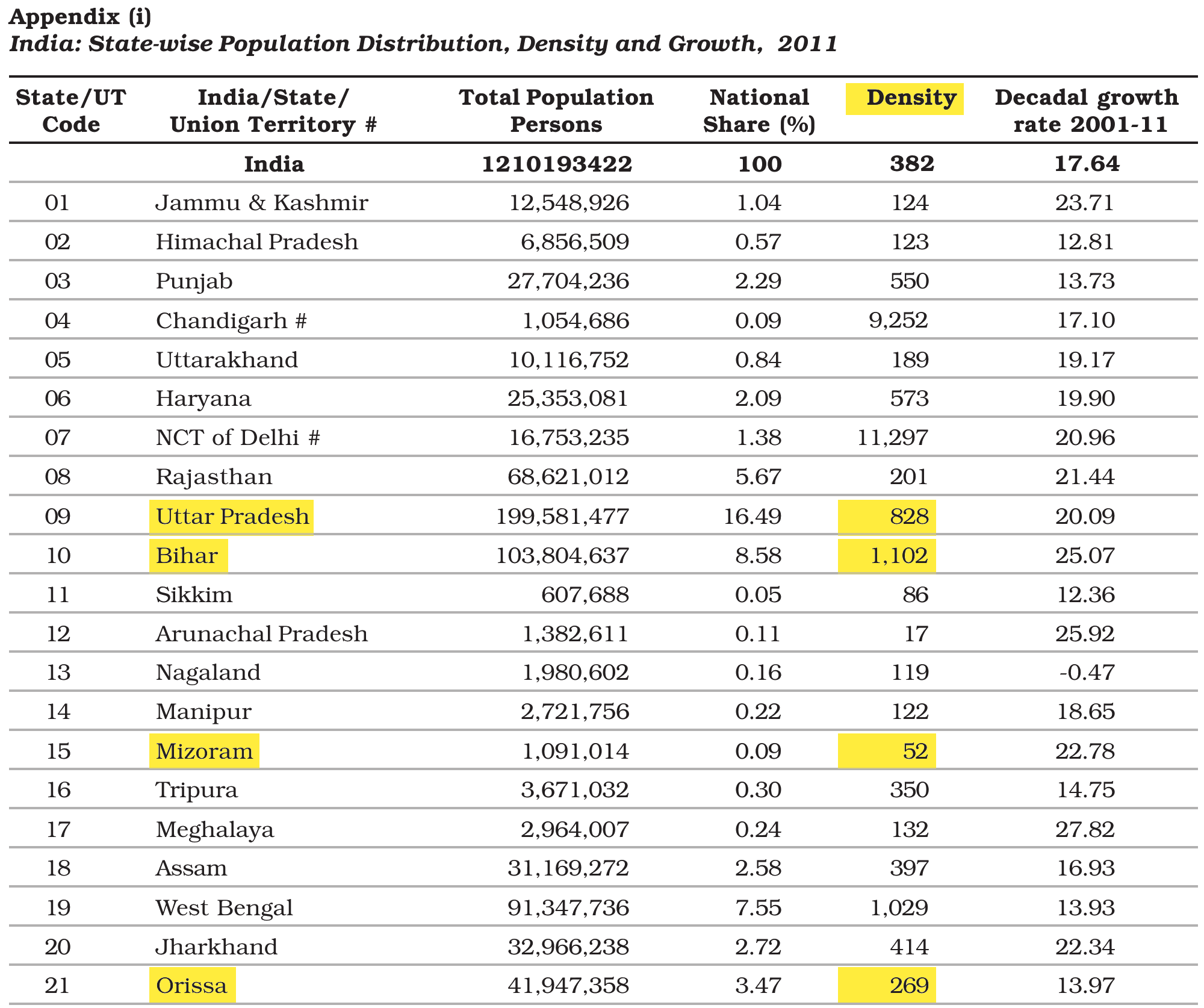
Arrange the states in a descending order of population density as per 2011 census.
(A) Odisha
(B) Uttar Pradesh
(C) Bihar
(D) Mizoram
Choose the correct answer from the options given below:
Answer & explanation
Correct answer: option 2
The correct answer is Option (2) → (C), (B), (A), (D)
(C) Bihar — first, with 1,102 persons per sq km.
(B) Uttar Pradesh — second, with 828 persons per sq km.
(A) Odisha — third, with 269 persons per sq km, a moderate density.
(D) Mizoram — last, with 52 persons per sq km, as the north-eastern states (except Assam) have low densities.
NCERT (2026-27): “The data shown in Appendix (i) give an idea of spatial variation of population densities in the country which ranges from as low as 17 persons per sq km in Arunachal Pradesh to 11,297 persons in the National Capital Territory of Delhi. Among the northern Indian States, Bihar (1102), West Bengal (1029) and and Uttar Pradesh (828) have higher densities, while Kerala (859) and Tamil Nadu (555) have higher densities among the peninsular Indian states. States like Assam, Gujarat, Andhra Pradesh, Haryana, Jharkhand, Odisha have moderate densities. The hill states of the Himalayan region and North eastern states of India (excluding Assam) have relatively low densities while the Union Territories (excluding Andaman and Nicobar islands) have very high densities of population (Appendix–i).”
Appendix (i): India: State-wise Population Distribution, Density and Growth, 2011 (part) |