
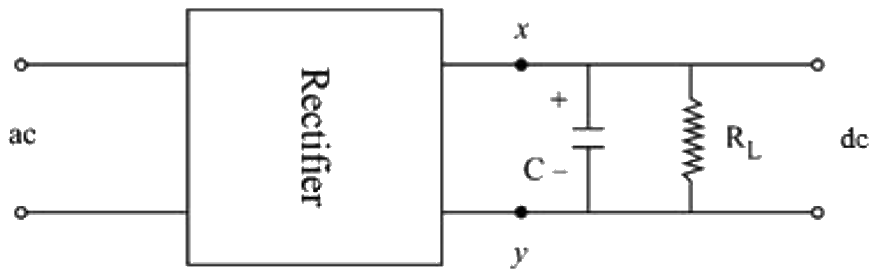
Based on the understanding operations of rectifies answer the questions Diodes can be used for rectifying on ac voltage (restricting the ac voltage to one direction) with the help of a capacitor or a suitable filter, a dc voltage ca be obtained.
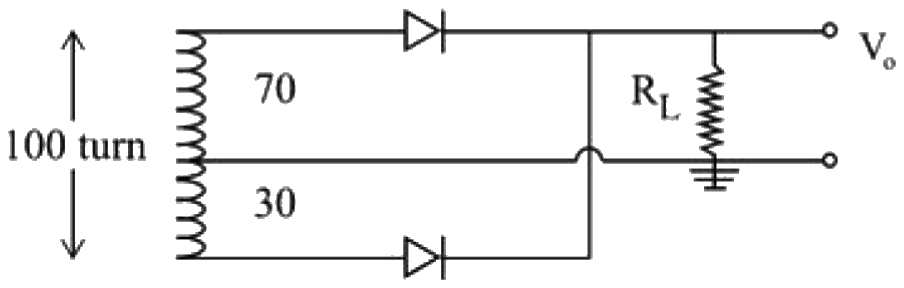
In a full wave rectifier using a 100 secondary turns centre tapped transformer and two diodes, the tapping is erroneously done over turn no. 30 as shown. The output voltage waveform will be as :
Answer & explanation
Correct answer: option 3
The correct answer is Option (3)
In a centre-tapped full wave rectifier, each diode conducts in one half-cycle, and each takes its voltage from its own half of the secondary. The emf induced in a winding is proportional to its number of turns.
Here the tap divides the 100 turns into 70 and 30 turns. If \( V_m \) is the peak emf across the whole secondary:
\( \displaystyle V_{1} = \frac{70}{100}\,V_m = 0.7\,V_m \quad (\text{half feeding the upper diode}) \)
\( \displaystyle V_{2} = \frac{30}{100}\,V_m = 0.3\,V_m \quad (\text{half feeding the lower diode}) \)
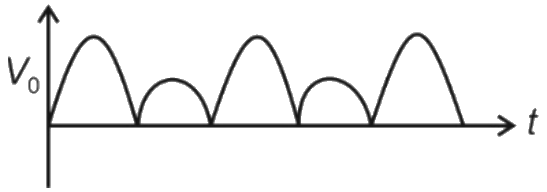
In one half-cycle the upper diode conducts and gives a pulse of peak \( 0.7\,V_m \) across \( R_L \); in the next half-cycle the lower diode conducts and gives a pulse of peak \( 0.3\,V_m \). Both diodes send the current through \( R_L \) in the same direction, so all the pulses are on the same side of the axis.
The output is therefore a full wave rectified wave whose humps are alternately tall and short, in the ratio \( 70 : 30 \), which is the waveform of Option (3).