


CUET Preparation Today
Which of the following reactions are given by Phenols? (A) Nitration Choose the correct answer from the options given above: |
(A), (B) and (D) only (A), (B) and (C) only (A), (B), (C) and (D) (B), (C) and (D) only |
(A), (B), (C) and (D) |
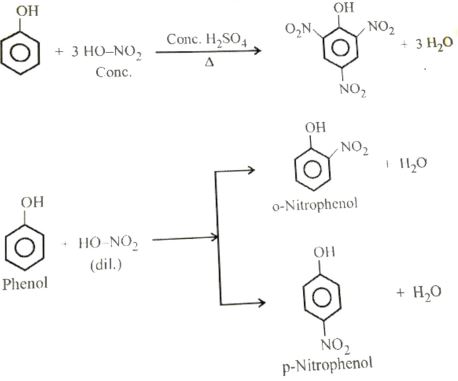
The correct answer is Option (3) → (A), (B), (C) and (D) Phenol contains a hydroxyl group (–OH) attached directly to a benzene ring. The –OH group shows a strong +M (electron donating) effect, which activates the benzene ring towards electrophilic substitution reactions. Because of this activation, phenols undergo several important reactions. Nitration Phenols easily undergo nitration due to the activating effect of the –OH group. Example: Phenol + dilute HNO₃ → o-nitrophenol and p-nitrophenol With concentrated nitric acid, 2,4,6-trinitrophenol (picric acid) is formed. Thus, phenols undergo nitration.
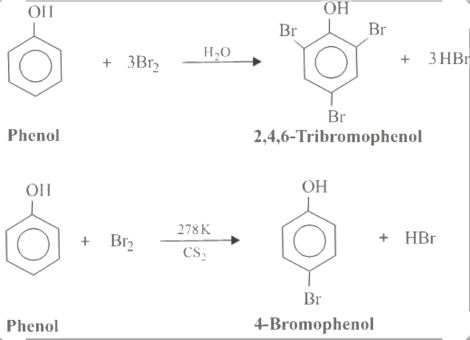
Halogenation Phenols react readily with halogens such as bromine. Example: Phenol + Br₂ (in water) → 2,4,6-tribromophenol Thus, phenols undergo halogenation.
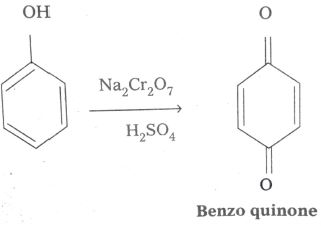
Oxidation Phenols can be oxidized to quinones using oxidizing agents. Example: Phenol → p-benzoquinone Thus, phenols undergo oxidation reactions.
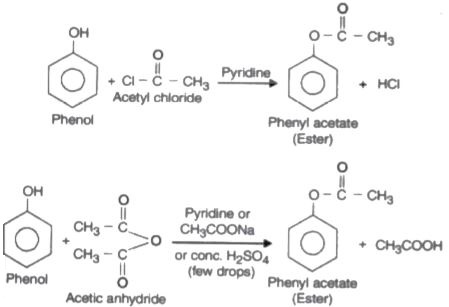
Acetylation Phenols react with acid chlorides or acid anhydrides to form esters. Example: Phenol + Acetic anhydride → Phenyl acetate Thus, phenols also undergo acetylation.
|