Which of the following cost curve takes the shape of rectangular hyperbola?
Answer & explanation
Correct answer: option 2
The correct answer is Option (2) → Average fixed cost curve
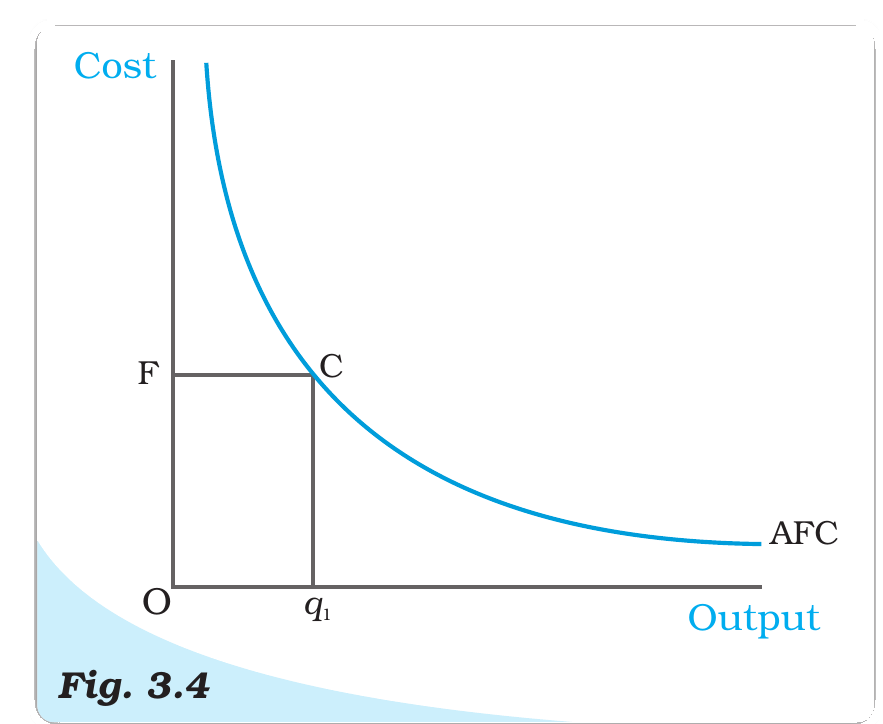
Fixed costs, such as the rent of a factory, do not change with output. Spread over more and more units, the same total gives a smaller cost per unit, so average fixed cost (AFC = TFC/q) keeps falling, yet AFC times output always gives back the same TFC. A curve on which the product of the two values stays constant is a rectangular hyperbola, and that is the shape of the AFC curve.
Because the product is fixed, the curve never touches either axis: near zero output AFC is very large, and at very large output it comes close to zero without reaching it.
Why the other options are incorrect
Option (1) Average variable cost curve — Incorrect. AVC first falls and then rises, because of the law of variable proportions, so it is U-shaped, not a rectangular hyperbola.
Option (3) Average total cost curve — Incorrect. ATC is AFC plus AVC. It falls at first, but once the rise in AVC outweighs the fall in AFC it rises, so it is also U-shaped.
Option (4) Marginal cost curve — Incorrect. MC first falls and then rises with output, so it is U-shaped too, and it cuts the AVC and ATC curves at their minimum points.
Note: A same/similar question was asked in CUET (UG) in the papers below.
| 2026 | 2025 | 2024 | 2023 | 2022 |
| 21-05 S1 | 30-05 S1* | – | – | – |
* A similar question.
NCERT (2025-26): “Shapes of the Short Run Cost Curves … AFC is the ratio of TFC to q. TFC is a constant. Therefore, as q increases, AFC decreases. When output is very close to zero, AFC is arbitrarily large, and as output moves towards infinity, AFC moves towards zero. AFC curve is, in fact, a rectangular hyperbola. If we multiply any value q of output with its corresponding AFC, we always get a constant, namely TFC.… …Figure 3.4 shows the shape of average fixed cost curve for a typical firm. We measure output along the horizontal axis and AFC along the vertical axis.…”
|