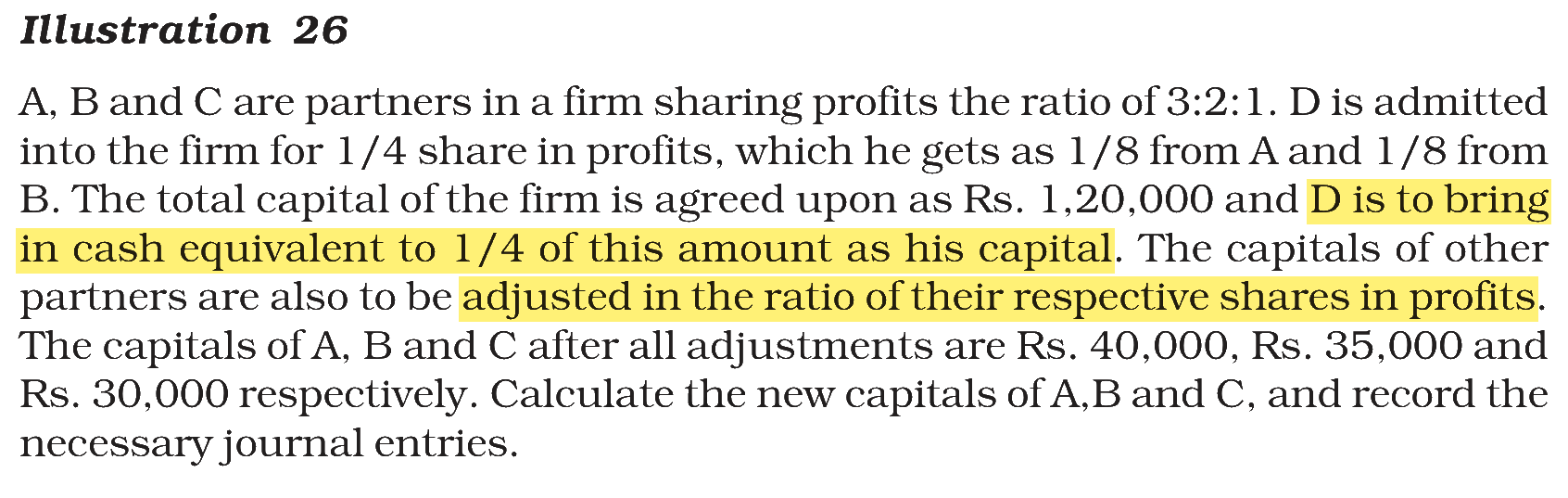
A, B and C are partners in a firm sharing profits in the ratio of 3:2:1. D is admitted into the firm for 1/4 share in profits, The total capital of the firm is agreed upon as Rs. 2,40,000 and D is to bring in cash equivalent to 1/4 of this amount as his capital. The capitals of other partners are also to be adjusted in the ratio of their respective shares in profits. The capitals of A, B and C after all adjustments are Rs. 80,000, Rs. 70,000 and Rs. 60,000 respectively. Calculate the new capitals of A, B and C,
Answer & explanation
Correct answer: option 2
The correct answer is Option (2) → A Rs. 90,000 ; B Rs. 60,000; C Rs. 30,000 ; D Rs. 60,000
When the total capital of the new firm is fixed, each partner’s capital is his share of that total in the new profit sharing ratio. The new partner’s capital is found first, and the rest is divided among the old partners.
New ratio:
D gets 1/4, so A, B and C keep 3/4
No sacrifice is specified, so A, B and C keep their old ratio of 3:2:1 within that 3/4
New capitals:
D = Rs. 2,40,000 × 1/4 = Rs. 60,000
Left for A, B and C = Rs. 2,40,000 − Rs. 60,000 = Rs. 1,80,000
A = Rs. 1,80,000 × 3/6 = Rs. 90,000
B = Rs. 1,80,000 × 2/6 = Rs. 60,000
C = Rs. 1,80,000 × 1/6 = Rs. 30,000
The adjusted capitals of Rs. 80,000, Rs. 70,000 and Rs. 60,000 only show who settles the difference: A brings in Rs. 10,000, B withdraws Rs. 10,000 and C withdraws Rs. 30,000. Had D taken his share as 1/8 each from A and B, the new ratio would change; the question gives no such condition, so A, B and C keep 3:2:1 among themselves.
Note: NTA picked this question from an NCERT (2026-27) illustration and changed the figures. Do not ignore NCERT while practising numericals.
NCERT (2026-27 edition):
|