Molecular basis of inheritance
Read the following passage carefully and answer the given questions.
In bacteria, since the mRNA does not require any processing to become active, and also since transcription and translation take place in the same compartment, many times the translation can begin much before the mRNA is fully transcribed. Translation refers to the process of polymerisation of amino acids to form a polypeptide. The order and sequence of amino acids are defined by the sequence of bases in the mRNA. In lac operon, a polycistronic structural gene is regulated by a common promoter and regulatory genes. Such arrangement is very common in bacteria and is referred to as operon. In prokaryotes, control of the rate of transcriptional initiation is the predominant site for control of gene expression. In a transcription unit, the activity of RNA polymerase at a given promoter is in turn regulated by interaction with accessory proteins, which affect its ability to recognise start sites. These regulatory proteins can act both positively and negatively. DNA from every tissue of an individual show the same degree of polymorphism, they become very useful identification tool in forensic applications like DNA fingerprinting.
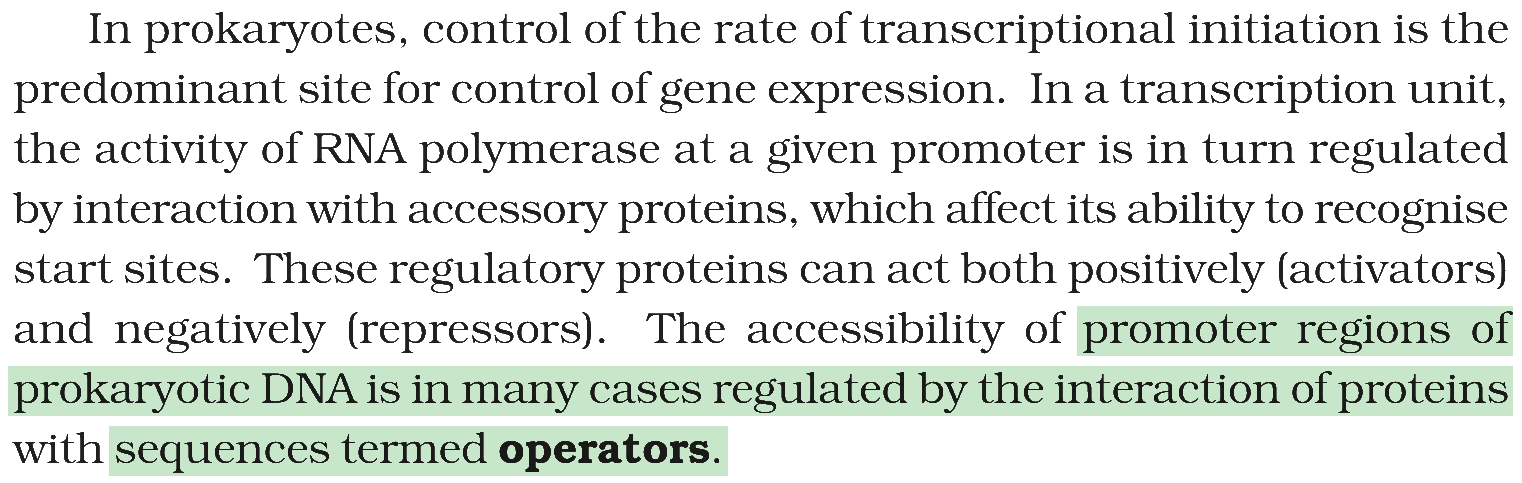
The accessibility of promoter regions of prokaryotic DNA is in many cases regulated by the interaction of proteins with
Answer & explanation
Correct answer: option 3
The correct answer is Option (3) → Operators
In prokaryotes, gene expression is controlled mainly at the start of transcription. Regulatory proteins can act positively (activators) or negatively (repressors).
(1) Regulators — Incorrect. The regulators are the regulatory proteins themselves. The question asks for the DNA sequence that these proteins bind to.
(2) Inducers — Incorrect. Inducers are small molecules such as lactose or allolactose. They bind the repressor protein, not the DNA.
(3) Operators — Correct. The accessibility of the promoter is regulated by proteins that bind to sequences called operators. The operator lies next to the promoter. In most cases it binds a repressor protein, and each operon has its own operator and its own repressor.
(4) Repressors — Incorrect. A repressor is a protein. It is the one that binds to the operator.
Note: The passage is taken from NCERT. NTA has put lines of the NCERT text together to make it. Most CUET (UG) questions come straight from NCERT, so study the book line by line, including figures and their titles.
NCERT Extract:
Regulation of Gene Expression – …