Reduction of Nitrobenzene by which of the following reagent gives aniline?
(A) \( Sn/HCl \)
(B) \( Fe/HCl \)
(C) \( H_2-Pd \)
(D) \( Sn/NH_4OH \)
Choose the correct answer from the options given below:
Answer & explanation
Correct answer: option 2
The correct answer is Option (2) → (A), (B) and (C) only
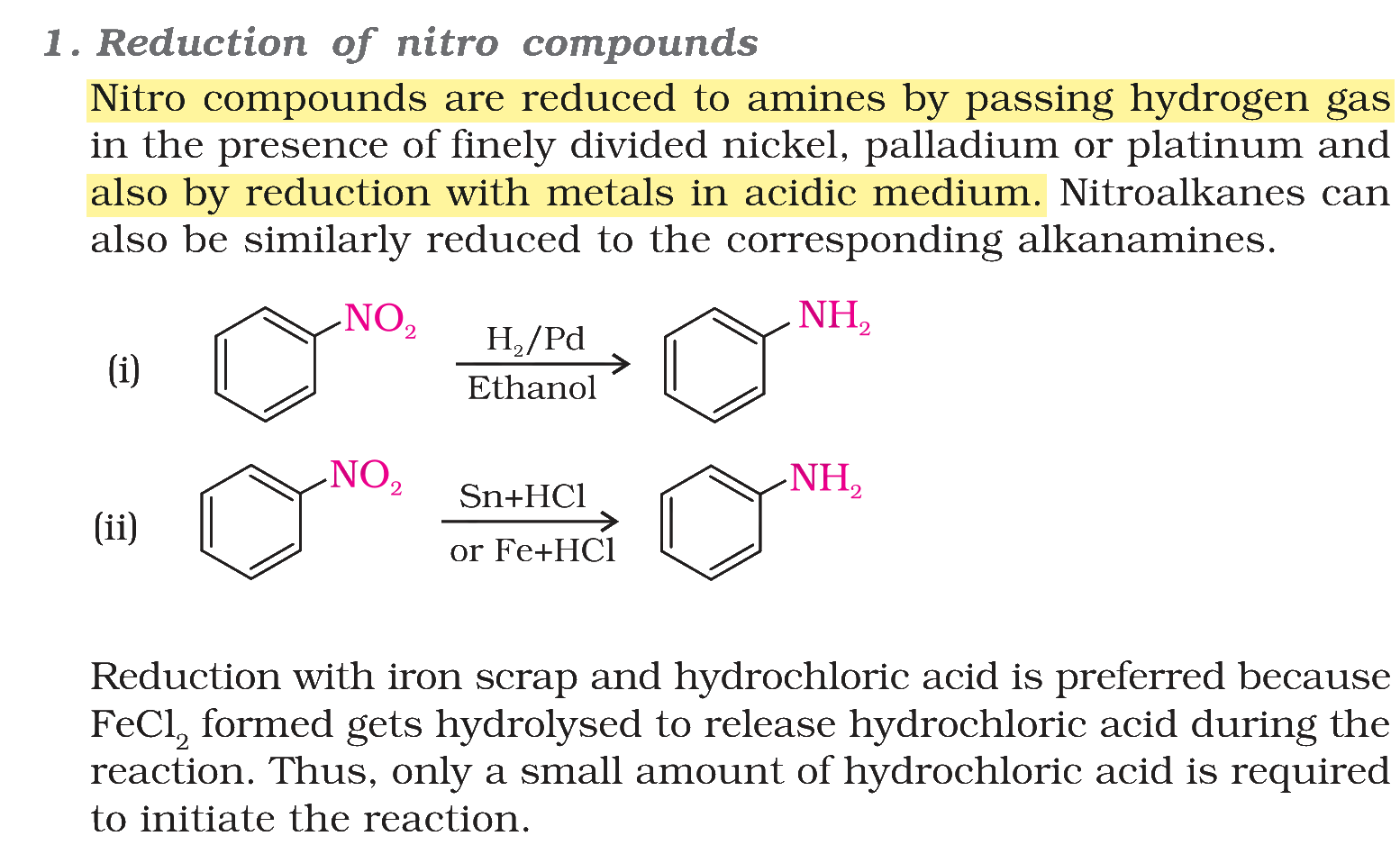
Nitrobenzene is reduced to aniline by six hydrogen atoms, the nitro group losing both its oxygen atoms as water. This needs either catalytic hydrogenation (\( \ce{H2} \) with finely divided Ni, Pd or Pt) or a metal in acidic medium, where the metal gives the electrons and the acid the protons:
\( \displaystyle \ce{C6H5NO2 + 6[H] -> C6H5NH2 + 2H2O} \)
(A) \(Sn/HCl\) — Correct. Tin and hydrochloric acid reduce nitrobenzene to aniline (obtained as the salt, from which aniline is set free by NaOH).
\( \displaystyle \ce{C6H5NO2 + 6[H]} \xrightarrow{\ce{Sn/HCl}} \ce{C6H5NH2 + 2H2O} \)
(B) \(Fe/HCl\) — Correct. Iron scrap and HCl also reduce the nitro group, and this is the preferred method.
\( \displaystyle \ce{C6H5NO2 + 6[H]} \xrightarrow{\ce{Fe/HCl}} \ce{C6H5NH2 + 2H2O} \)
(C) \(H_2-Pd\) — Correct. Hydrogen gas over finely divided palladium reduces the nitro group catalytically.
\( \displaystyle \ce{C6H5NO2 + 3H2} \xrightarrow[\text{ethanol}]{\ce{Pd}} \ce{C6H5NH2 + 2H2O} \)
(D) \(Sn/NH_4OH\) — Incorrect. Reduction to the amine needs a metal in acidic medium. In a basic medium the acid that supplies the protons is missing, and reductions of nitrobenzene in neutral or alkaline media stop at other products, such as N-phenylhydroxylamine or the coupled azoxy- and azobenzene.
NCERT (2026-27 edition):
Reduction of Nitro Compounds