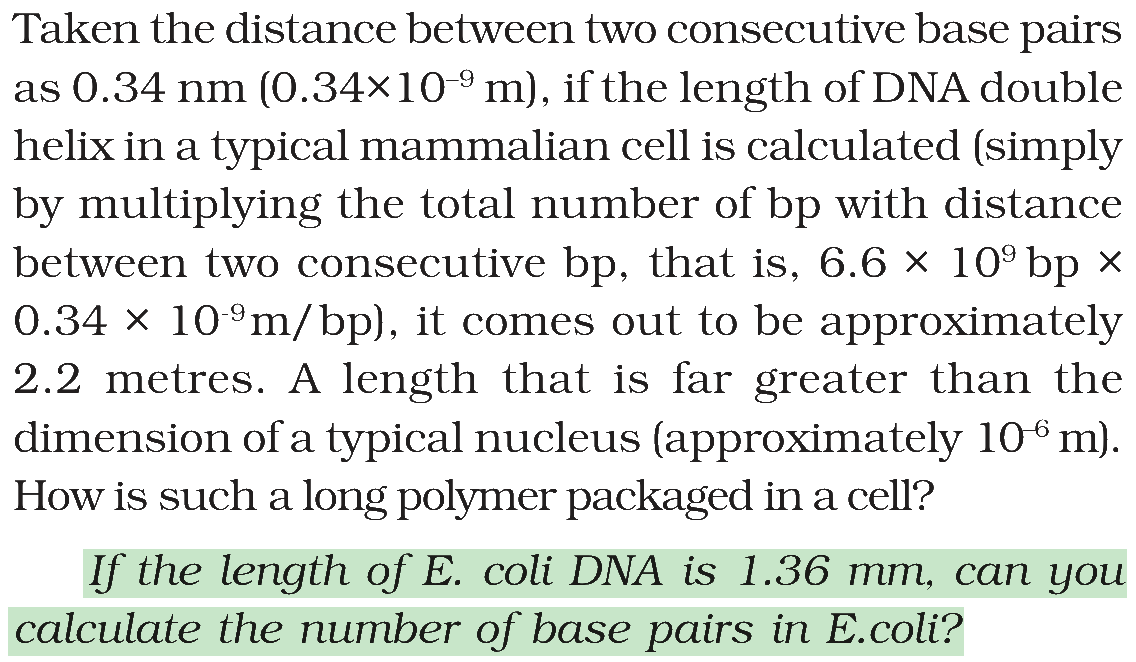
If the length of E. coli DNA is 1.36 mm, calculate the number of base pairs in E. coli. (Considering the distance between two consecutive base pairs is \( 0.34 \times 10^{-9} \) m)
Answer & explanation
Correct answer: option 3
The correct answer is Option (3) → \( 4 \times 10^{6} \) bp
The two strands of DNA are held together as base pairs (bp), and the distance between two consecutive base pairs is about 0.34 nm. So the length of a DNA molecule is the number of base pairs multiplied by this distance.
\( \displaystyle \text{Number of bp} = \frac{\text{length of DNA}}{\text{distance between two bp}} \)
The length must be in metres first.
\( 1.36\ \text{mm} = 1.36 \times 10^{-3}\ \text{m} \)
\( \displaystyle \text{Number of bp} = \frac{1.36 \times 10^{-3}}{0.34 \times 10^{-9}} \)
\( = 4 \times 10^{6} \)
So E. coli DNA has about 4 million base pairs. NCERT gives 4.6 × 10⁶ bp for E. coli, which is close to this value.
(1) \( 4 \times 10^{4} \) bp — Incorrect. It is 100 times too small.
(2) \( 6 \times 10^{6} \) bp — Incorrect. The division does not give 6.
(3) \( 4 \times 10^{6} \) bp — Correct. It is the result worked out above.
(4) \( 4 \times 10^{9} \) bp — Incorrect. It is 1000 times too large.
NCERT Extract:
Packaging of DNA Helix – …