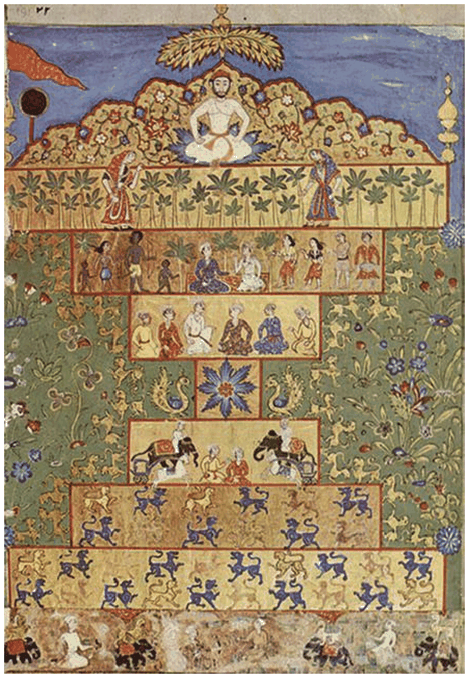
The Bijapur encyclopaedia Nujum al-Ulum has a page called The Throne of Prosperity, an auspicious throne of seven stages. Each stage is supported by different inhabitants. Arrange the following parts of this painting from the base of the throne to its top:
(A) Palm trees
(B) Elephants and tigers
(C) Deccani foliage against a deep blue sky
(D) Storeys of peacocks and primitive tribes
Choose the correct answer from the options given below:
Answer & explanation
Correct answer: option 2
The correct answer is Option (2) → (B), (D), (A), (C)
(B) comes first. The stages of the throne run from elephants and tigers at its base.
(D) is second. The stages pass through storeys of peacocks and primitive tribes on the way up.
(A) is third. The stages end at palm trees, just below the top of the throne.
(C) is last. The throne is surmounted by Deccani foliage against a deep blue sky.
Note: This topic was not named in the CUET 2026 syllabus, but it was part of the NCERT chapter. In 2025 and 2026, NTA also asked questions on topics in NCERT that the CUET syllabus did not name. So our mocks have questions from every part of the NCERT chapter, to give you enough practice. Read the whole chapter, not only the sub-topics named in the syllabus.
NCERT (2026-27): “Bijapur School of Painting …The Throne of Prosperity is a symbolic diagram of an auspicious throne of seven stages, each supported by different inhabitants — from elephants and tigers to palm trees, through storeys of peacocks and primitive tribes. The basic structures recall the wood carved doorways and facades of Gujarati homes or perhaps remind us of the temples of the Deccan. The colouring of this page is in Islamic Persian tradition, especially, the arabesques on the top of the throne. We see it is surmounted by a Deccani foliage against amazingly deep blue sky.…”
Nujum al-Ulum: The Throne of Prosperity, Bijapur, 1570, The Chester Beatty Library, Dublin, Ireland |