CUETMOCK
  • Pricing
  • Mentors
Log inStart freeStart free mocks→

First test, then trust

Try a free CUET mock test.

Join 5,00,000+ students who rehearsed exam day on the exact NTA screen before sitting CUET. On the web and on Android.

Start free mocks →Get the Android app
CUETMOCK

India's #1 CUET Mock Test Platform. Original NCERT-based questions on the exact NTA exam screen — trusted by 5,00,000+ students since CUET 2022.

Get it onGoogle PlayScan to download the CUETMOCK app

Mock tests

  • CUET mock test series
  • Browse all papers
  • Commerce mocks
  • Humanities (Arts) mocks
  • Science mocks
  • Languages & GAT mocks
  • Free practice questions
  • Pricing

Resources

  • CUET exam guide
  • CUET syllabus
  • Universities accepting CUET
  • Expert blogs
  • News & notifications
  • Webinars & counselling
  • CUET score calculator
  • How we estimate your rank
  • FAQs

Company

  • About us
  • Our leadership & team
  • Our toppers
  • Mentors
  • For schools
  • Contact us
  • Terms
  • Privacy
  • Refund policy

Talk to us

+91 7696 6630 56info@cuetmock.comWhatsApp us

Our other platforms

  • JEE Mock — For IIT-JEE aspirants
  • NEET Mock — For NEET aspirants

Newsletter

Exam updates, study material and offers — no spam.

© 2026 NYC Ventures Pvt. Ltd.

701-702, Royal Business Park, Zirakpur, Punjab - 140603

  • Terms of use
  • Privacy policy
  • Refund policy
  • Contact us

iCUETMOCK is an independent preparation platform, not affiliated with the National Testing Agency (NTA). Always check exam details on the official NTA website.

  • Home
  • Mock tests
  • CUET guide
  • Pricing
  • Log in
Home/Practice questions/History
HistoryAncient India: Thinkers, Beliefs and Buildings

Arrange the events related to Buddha in chronological order. (A) Renu…

Arrange the events related to Buddha in chronological order.

(A) Renunciation of the world
(B) Enlightenment
(C) Sutta Pitaka
(D) First Sermon
(E) Birth

Choose the correct answer from the options given below:

Answer & explanation+

Correct answer: option 4

The correct answer is Option (4) → (E), (A), (B), (D), (C)

(E) Birth — Siddhartha, as the Buddha was named at birth, was the son of a chief of the Sakya clan and had a sheltered upbringing within the palace.

(A) Renunciation of the world — moved by the sight of an old man, a sick man and a corpse, and by a homeless mendicant who had found peace, he left the palace and set out in search of his own truth.

(B) Enlightenment — after exploring several paths, he meditated for several days and attained enlightenment (at Bodh Gaya); after this he came to be known as the Buddha.

(D) First Sermon — he then gave his first sermon at Sarnath, and for the rest of his life he taught dhamma.

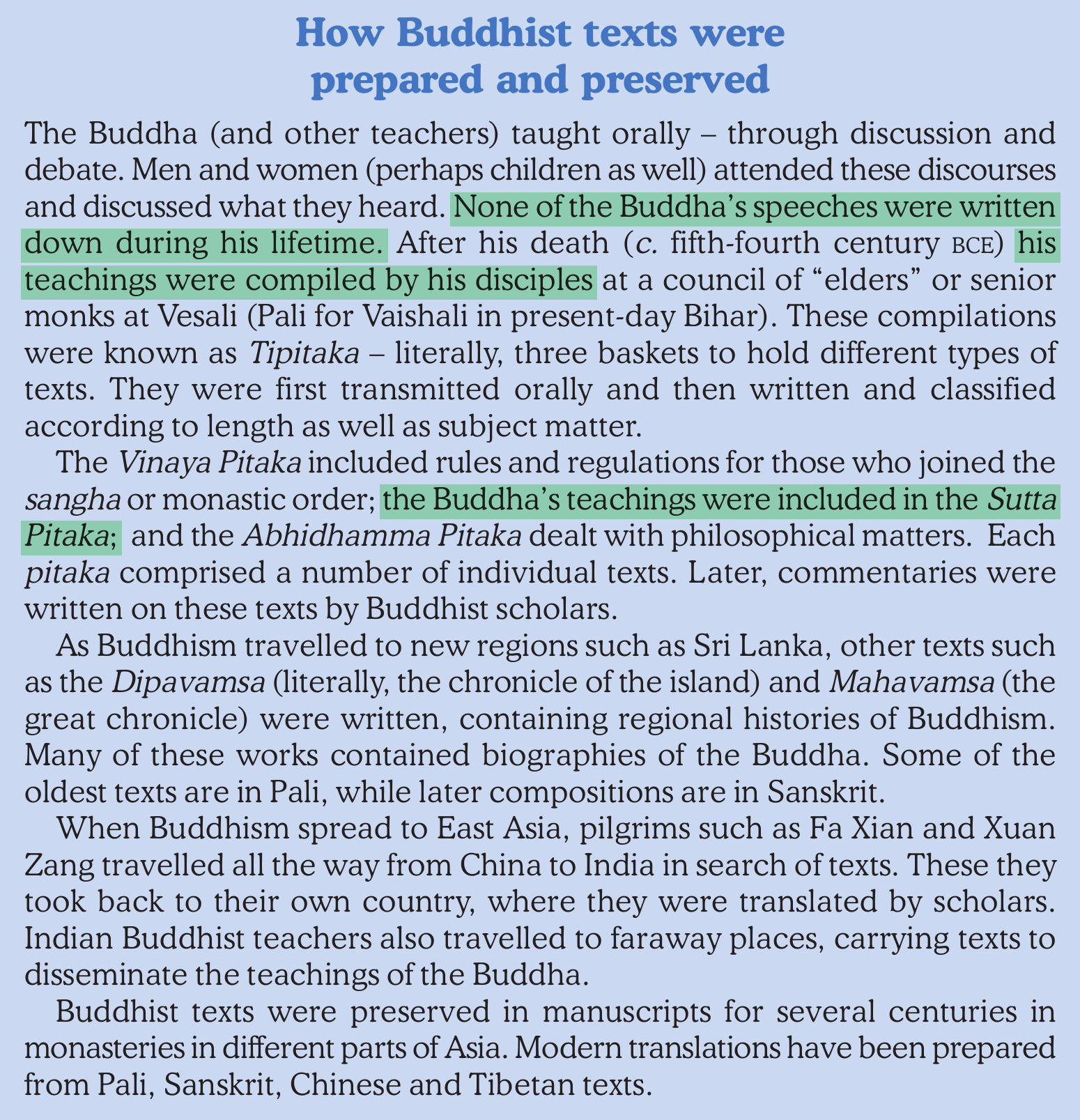
(C) Sutta Pitaka — none of the Buddha’s speeches was written down during his lifetime. After his death his disciples compiled his teachings, and the Buddha’s teachings were included in the Sutta Pitaka.


NCERT (2026-27): “4. The Buddha and the Quest for Enlightenment … He had a sheltered upbringing within the palace, insulated from the harsh realities of life. One day he persuaded his charioteer to take him into the city. His first journey into the world outside was traumatic. He was deeply anguished when he saw an old man, a sick man and a corpse. He realised in that moment that the decay and destruction of the human body was inevitable. He also saw a homeless mendicant, who, it seemed to him, had come to terms with old age, disease and death, and found peace. Siddhartha decided that he too would adopt the same path. Soon after, he left the palace and set out in search of his own truth. Siddhartha explored several paths including bodily mortification which led him to a situation of near death. Abandoning these extreme methods, he meditated for several days and finally attained enlightenment. After this he came to be known as the Buddha or the Enlightened One. For the rest of his life, he taught dhamma or the path of righteous living.

9.2 Symbols of worship … The empty seat … was meant to indicate the meditation of the Buddha, and the stupa … was meant to represent the mahaparinibbana. Another frequently used symbol was the wheel …. This stood for the first sermon of the Buddha, delivered at Sarnath.…”

NCERT extract

Advertisement

Practise more on Ancient India: Thinkers, Beliefs and Buildings

Chapter-wise mocks on the real NTA exam screen, with solutions and your rank. Your first mocks are free.

Start free mocks →

Advertisement

Next questions

  1. What is the difference (in Rs.) between the interest on Rs. 40,000 for one year at 12% per annum compounded half yearly and yearly?General Aptitude Test · Numerical Ability
  2. In which year was the European Union awarded the Nobel Peace Prize?Political Science · Contemporary World Politics: Contemporary Centres of power
  3. Select the related alphabet from the given alternatives: TRACK : MECTV :: SAND : ?General Aptitude Test · General Ability
  4. Consider the following statements about the V-I characteristic of a p-n junction diode:(A) The cut-in voltage is about 0.2 V for a germaniu…Physics · Semiconductors and Electronic Devices
  5. Read the given statements and conclusions carefully. Assuming that the information given in the statements is true, even if it appears to b…General Aptitude Test · Verbal Reasoning
  6. Choose the most appropriate option to fill in the blank:My grandmother has been feeling much better ______ she started her morning walks in…English · Grammar: Conjunction
  7. Fill in the blank:______ allows trainees to interact with other employees, facilitating future cooperation among departments.Business Studies · Staffing
  8. Select the option that is related to the fifth letter-cluster in the same way as the second letter-cluster is related to the first letter-c…General Aptitude Test · General Ability
  9. Which of the following is true of mechanisation?Geography · Fundamentals of Human Geography: Secondary Activities
  10. If x^2 +1/(x^2)=4 , then what is the value of x^4 +1/(x^4).General Aptitude Test · Quantitative Reasoning