Reaction of Chloroethane with ethanolic ammonia will result in
Answer & explanation
Correct answer: option 4
The correct answer is Option (4) → Quaternary ammonium salt
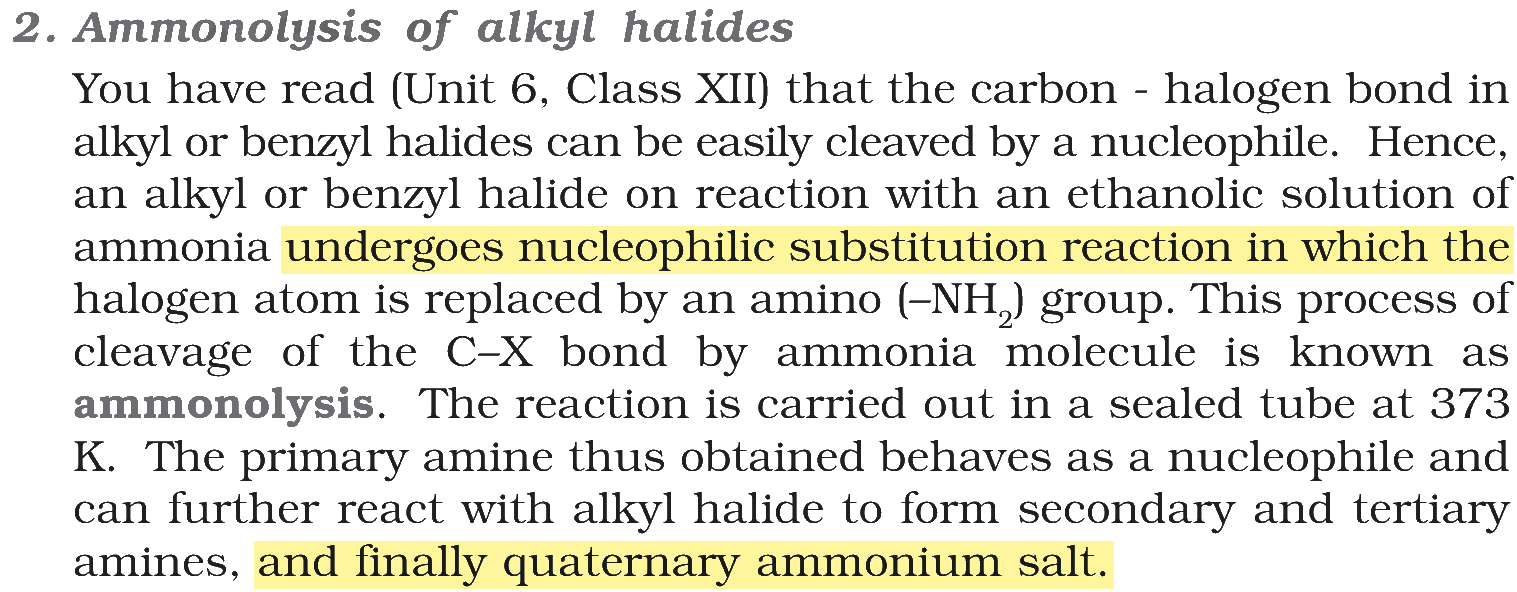
In ammonolysis, an alkyl halide is heated with ethanolic ammonia (in a sealed tube at about 373 K). Ammonia, a nucleophile, replaces the halogen by an amino group. The amine formed also has a lone pair on nitrogen, so it is itself a nucleophile and reacts with more alkyl halide. Alkylation goes on step by step until nitrogen has no hydrogen left, ending in the quaternary ammonium salt.
With chloroethane, each step adds one ethyl group to nitrogen:
\( \displaystyle \ce{C2H5Cl + NH3 -> C2H5NH2 + HCl} \)
\( \displaystyle \ce{C2H5NH2 + C2H5Cl -> (C2H5)2NH + HCl} \)
\( \displaystyle \ce{(C2H5)2NH + C2H5Cl -> (C2H5)3N + HCl} \)
\( \displaystyle \ce{(C2H5)3N + C2H5Cl -> (C2H5)4N+Cl-} \)
(The HCl formed in each step is taken up by the amine present as its ammonium salt.) The series ends with tetraethylammonium chloride, so the reaction finally results in a quaternary ammonium salt. The reaction actually gives a mixture of all four products; the primary amine becomes the major product only when a large excess of ammonia is used.
Why the other options are incorrect
Option (1) Ethanamine — Incorrect. It is the first product, but it reacts further with chloroethane; it is the main product only with a large excess of ammonia.
Option (2) N-Ethylethanamine — Incorrect. This secondary amine is an intermediate, formed when ethanamine is ethylated once more.
Option (3) N,N-Diethylethanamine — Incorrect. This tertiary amine still has a lone pair and is ethylated once more to the quaternary salt.
NCERT (2026-27 edition):
Ammonolysis of Alkyl Halides